

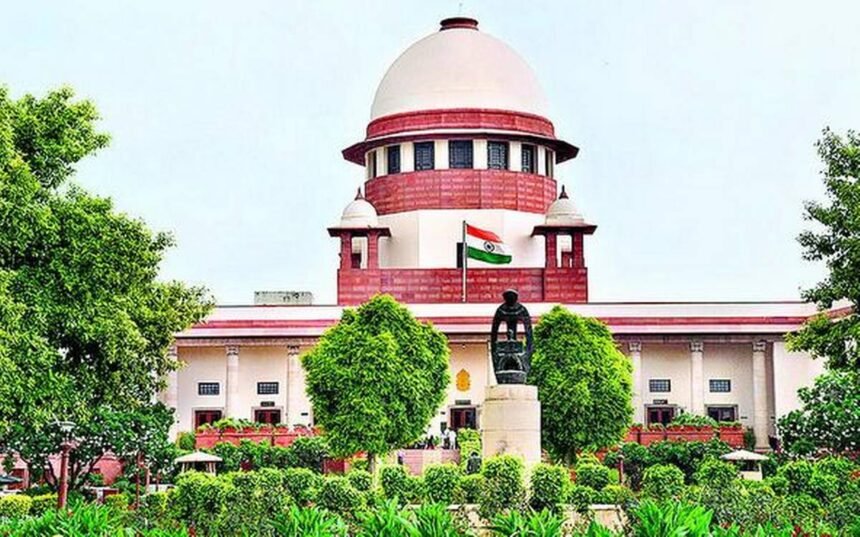
New Delhi – In a landmark order with far-reaching implications, the Supreme Court has expressed serious concern over the “widespread and blatant violations” of building bye-laws and land-use regulations across the country, particularly the unauthorized conversion of residential properties into commercial establishments. The Court has now converted the issue into a pan-India matter, impleading Municipal Corporations and Municipalities of all State capitals and Union Territories as respondents and directing them to conduct a comprehensive inquiry and submit detailed affidavits identifying every such violation in their jurisdictions. A two-judge bench comprising Hon’ble Mr. Justice Ahsanuddin Amanullah and Hon’ble Mr. Justice R. Mahadevan passed the order today while hearing a Miscellaneous Application in SLP(C) Nos. 8044-8045/2025 (Loganathan vs. The State of Tamil Nadu & Others.).The Court observed:
“From the facts emerging in the present proceedings, and from similar matters coming before this Court, it is evident that there are apparent widespread and blatant violations of building bye-laws and land-use regulations. Constructions are frequently undertaken in blatant violation of the applicable norms and regulations, including in the prohibited areas. More importantly, upon completion, such lands and buildings are often put to uses other than those for which sanction was originally granted by the competent authority.
“We have also been coming across cases where residential colonies are being converted into commercial areas by the unauthorised use of residential buildings and lands for commercial purposes. Such practices are not only contrary to law and public interest, but also cause significant inconvenience and prejudice to bona fide residents, who have invested substantial resources in purchasing property and constructing their houses. The environmental and civic consequences of such misuse by unscrupulous elements of society are equally serious and have far-reaching implications.”
In view of the above, the Court has decided to examine the issue on a pan-India basis.
Key Directions Issued by the Supreme Court
- All Municipal Corporations and Municipalities of the capital cities of every State and Union Territory have been impleaded as party respondents.
- These authorities must conduct a comprehensive inquiry within their respective jurisdictions to identify areas demarcated exclusively for residential use but being misused for non-residential (commercial) purposes.
- A detailed list of all such violations must be prepared and placed before the Court through affidavits personally affirmed by the Commissioners of the concerned Corporations/Municipalities.
- The exercise must cover the entire jurisdiction, including all “islands” that may technically lie outside municipal limits but are surrounded by or located within the Corporation/Municipality area, as well as all residential colonies, group housing societies, and similar developed areas.
Background of the CaseThe order stems from an earlier Supreme Court directive dated 16.02.2026 in the same SLP, where the Court had dismissed the petitioner’s plea but took strong note of how Loganathan managed to construct a full G+1 floor building without any approved sanction plan. The Court had remarked that such a structure could not have come up without “collusion and connivance” of municipal authorities.In today’s order, the Court noted that the Commissioner of Greater Chennai Corporation has filed an affidavit claiming the violation occurred when the site fell under Madhavaram Municipality (before it came under Chennai Corporation limits). However, the bench expressed dismay over an order dated 22.03.2024 passed by the Additional Secretary (Technical), Housing and Urban Development Department, Chennai, which granted relief to violators by directing “no coercive action” despite a High Court directive for strict compliance with law.The Court has now directed the State of Tamil Nadu to file an affidavit within four weeks, disclosing the names of the officer(s) responsible for the 22.03.2024 order and explaining how such an order was passed.Strong Observations on Municipal CollusionReferring to the original construction violation, the Supreme Court had earlier stated:
More Read

“It speaks volumes about the conduct and the responsibility of the Municipal Corporation… A full one and a half storied building getting constructed and not even noticed by the Authorities… indicates an alarming state of affairs as the same could not have been done without the collusion and connivance of the Municipal Authorities.”
The Court had also directed the Municipal Corporation to submit a report explaining how the situation was allowed to develop. The present order keeps the issue of demolition/regularization in abeyance for the time being while the larger pan-India exercise proceeds.