

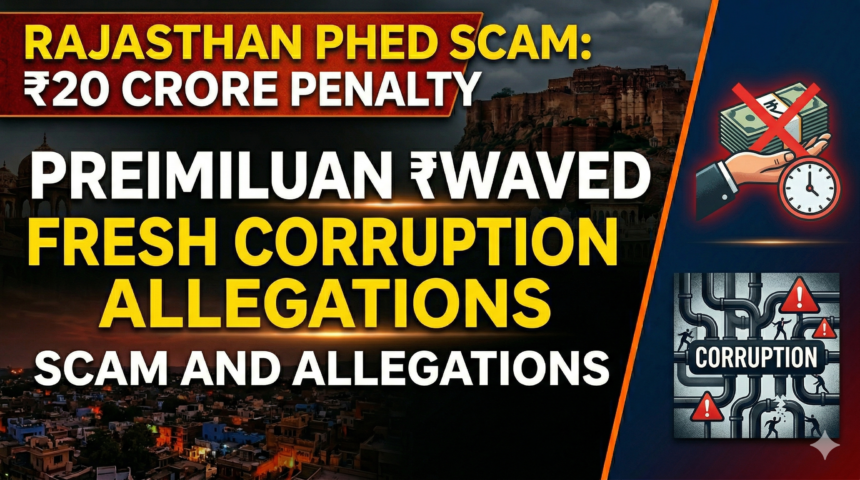
Jaipur, Rajasthan: A new controversy has surfaced in Rajasthan’s Public Health Engineering Department (PHED), where allegations of irregularities involving the waiver of nearly ₹20 crore in penalties have triggered concerns over corruption, favoritism, and misuse of public funds. The मामला has intensified scrutiny on the functioning of the department, already under the scanner in multiple ongoing investigations.
₹20 Crore Penalty Waiver Under Question
According to reports and complaints, penalties amounting to approximately ₹20 crore—reportedly imposed on contractors or firms for delays, poor-quality work, or contractual violations—were allegedly waived under questionable circumstances.
Such penalties are typically enforced to ensure accountability and compliance in government projects, especially in critical sectors like water supply. The alleged waiver has raised serious questions:
- Why were penalties waived despite violations?
- Who authorized the decision?
- Were rules bypassed to benefit select contractors?
Experts say such waivers, if done without proper justification, can result in direct financial losses to the state exchequer.
Link to Larger PHED and JJM Controversies
The development comes amid ongoing investigations into large-scale irregularities in PHED projects, particularly under the Jal Jeevan Mission (JJM).
More Read

Recent probes by the Anti-Corruption Bureau (ACB) have already revealed:
- Tender manipulation and forged documents used to secure contracts worth hundreds of crores
- Collusion between private firms and senior officials
- Policy violations that enabled inflated project costs
Investigations in related cases have indicated corruption running into hundreds and even thousands of crores, suggesting systemic issues within the department.
Allegations of Favoritism and Contractor Nexus
Sources allege that the penalty waiver may not be an isolated decision but part of a broader pattern of favoritism toward certain contractors.
More Read

Key concerns include:
- Selective relaxation of contractual rules
- Possible nexus between officials and private firms
- Lack of transparency in decision-making
If proven, such actions could indicate deliberate efforts to shield contractors from financial liability, undermining accountability mechanisms.
Financial and Administrative Impact
The alleged waiver of ₹20 crore has both financial and governance implications:
- Direct loss to government revenue
- Weakening of enforcement mechanisms in public contracts
- Encouragement of non-compliance among contractors
In departments like PHED, where large-scale infrastructure projects are executed, strict enforcement of penalties is crucial to maintain quality and timelines.
Pattern of Irregularities in PHED
The PHED has been repeatedly in the spotlight for alleged irregularities. Previous investigations have highlighted:
- Fake experience certificates used in tenders
- Manipulated bidding processes
- Arrest of multiple senior engineers and officials
- Multi-crore corruption cases under probe
These repeated controversies point toward deeper systemic lapses in procurement, monitoring, and administrative oversight.
More Read
Demand for Investigation
Following the latest allegations, there are growing demands for:
- A high-level independent probe into the ₹20 crore penalty waiver
- Audit of all penalty-related decisions in PHED projects
- Identification and action against responsible officials
- Strengthening of transparency in contract enforcement
Activists argue that without strict action, such practices could continue unchecked, leading to further losses.
Impact on Public Services
The PHED plays a critical role in providing drinking water and infrastructure across Rajasthan. Any corruption or mismanagement within the department can have direct consequences:
- Delayed or poor-quality water supply projects
- Increased burden on public funds
- Reduced efficiency in implementation of welfare schemes
Experts warn that governance failures in such essential services can affect millions of citizens.
Conclusion
The ₹20 crore penalty waiver controversy has added another layer to the growing list of allegations against Rajasthan’s PHED. With multiple scams already under investigation, the latest मामला underscores the urgent need for accountability, transparency, and systemic reforms.
As pressure mounts, the focus will now be on whether authorities initiate a thorough investigation and take strict action against those found responsible, ensuring that public funds are protected and governance standards upheld.