


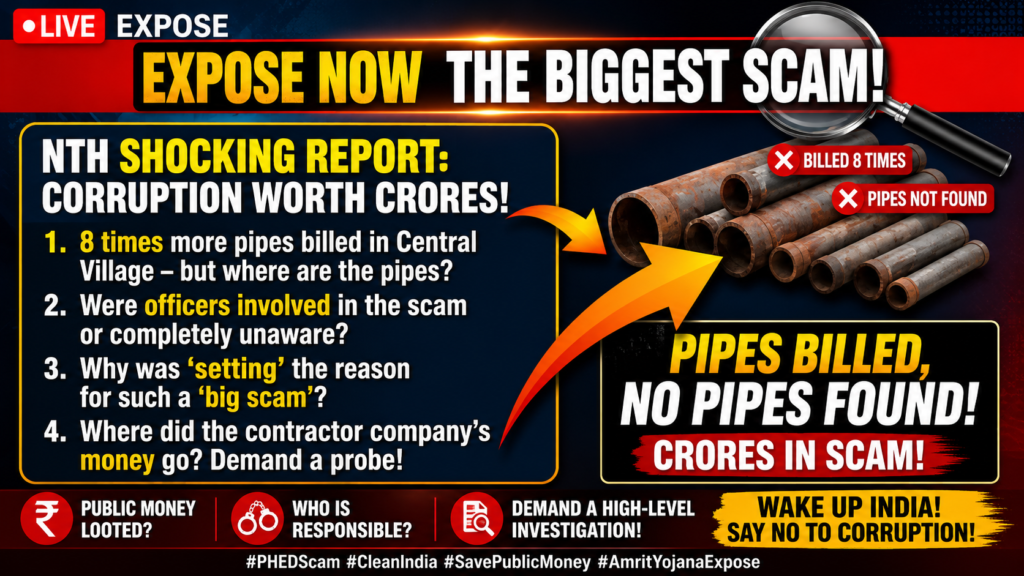
Jaipur: A fresh controversy has emerged around Rajasthan’s AMRUT 2.0 urban water supply programme after allegations that the Public Health Engineering Department (PHED) permitted the use of High-Density Polyethylene (HDPE) pipes that had reportedly failed mandatory quality tests.
The allegations have triggered serious concerns over construction quality, public expenditure, and the long-term durability of the state’s drinking water infrastructure. If proven, the case could expose major lapses in quality assurance within one of Rajasthan’s key urban water projects.
Laboratory Tests Allegedly Raised Red Flags
According to documents and allegations highlighted in the investigation, samples of HDPE pipes supplied for the project reportedly failed prescribed laboratory quality parameters. Despite these findings, questions are being raised over whether the same material continued to be approved and installed in the field.
Critics argue that the use of substandard pipeline material could significantly reduce the lifespan of the water distribution network, increase maintenance costs, and lead to leakages and water losses in the future.

₹205-Crore Project Faces Fresh Scrutiny
The controversy centres around a water supply project worth approximately ₹205 crore being implemented under the AMRUT 2.0 (Atal Mission for Rejuvenation and Urban Transformation) programme.
More Read

The scheme aims to strengthen urban drinking water infrastructure by laying new pipelines, improving water distribution systems, and providing reliable tap water to residents. Any compromise in material quality could directly affect the project’s objectives and public investment.
Questions Over PHED’s Quality Control Mechanism
The allegations have also raised concerns about PHED’s internal inspection and approval process.
Key questions being asked include:
More Read

- Were failed laboratory reports ignored during procurement or execution?
- Who authorised the acceptance of the allegedly non-compliant HDPE pipes?
- Were independent third-party inspections conducted before installation?
- Were contractual quality standards relaxed during execution?
If quality control protocols were bypassed, experts believe responsibility may extend beyond suppliers to supervising engineers and approving authorities.
Potential Risks to Water Infrastructure
Engineers note that HDPE pipes form the backbone of modern drinking water networks due to their durability and corrosion resistance. However, if the material does not meet required specifications, several operational problems may arise, including:
- Premature pipeline failures
- Frequent leakages and bursts
- Higher maintenance expenditure
- Water contamination risks due to damaged pipelines
- Reduced service life of the project
Such failures could ultimately increase the financial burden on both the government and consumers.
Demand for Independent Investigation
Following the allegations, demands have intensified for an independent technical audit of the project.
Experts and transparency advocates have called for:
- Re-testing of all pipe batches already supplied.
- Verification of laboratory reports and inspection records.
- Physical inspection of installed pipelines.
- Fixing accountability if procurement norms or quality standards were violated.
- Action against officials and suppliers if irregularities are established.
Background: Infrastructure Projects Under Increased Scrutiny
The allegations come at a time when public infrastructure and water supply projects across Rajasthan are already under close scrutiny following investigations into procurement and tender-related irregularities in the water sector. Recent investigations into the state’s drinking water schemes have highlighted concerns regarding tender processes, project execution, and quality oversight.
More Read

While the present allegations relating to the AMRUT 2.0 project require official verification, they have intensified public debate over transparency, quality assurance, and accountability in taxpayer-funded infrastructure projects.
Awaiting Official Response
At the time of publication, no detailed official clarification addressing the specific allegations regarding the reported failed HDPE pipe tests had been noted. Any official response or findings from a departmental inquiry would be crucial in determining whether quality standards were compromised during execution.