

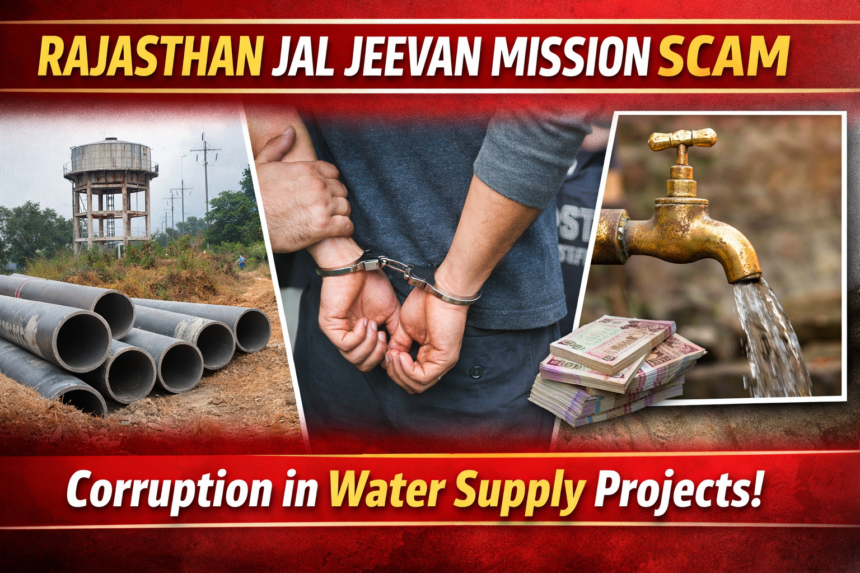
Jaipur: The Public Health Engineering Department (PHED) of Rajasthan has come under intense scrutiny following serious allegations of corruption, financial mismanagement, and irregularities in the implementation of the Jal Jeevan Mission.
The issue has triggered multiple investigations by state and central agencies, raising concerns over the execution of one of India’s most ambitious rural drinking water programs.
Background of the Scheme
Launched in 2019, the Jal Jeevan Mission aims to provide functional household tap connections to every rural household in India. The scheme targets a supply of 55 litres of potable water per person per day and is considered a crucial step toward improving public health and rural infrastructure.
Rajasthan, a water-scarce state, has been one of the major beneficiaries of the scheme, with thousands of crores allocated for pipeline networks, water supply systems, and infrastructure development.
Allegations of Financial Irregularities
Investigations have revealed large-scale irregularities in tender allocation and project execution within the PHED. According to reports, several firms allegedly secured contracts using forged experience certificates and manipulated documentation, despite lacking the required qualifications.
More Read

These contracts involved works such as:
- Laying water pipelines
- Installing pumps and tubewells
- Constructing overhead water tanks
Authorities suspect that a nexus between officials, contractors, and intermediaries enabled these firms to win tenders in exchange for commissions and bribes.
Multi-Agency Crackdown
The crackdown has intensified in recent months, with the Anti-Corruption Bureau (ACB) and other agencies carrying out arrests and raids across the state.
More Read
- Former IAS officer Subodh Agarwal was arrested in connection with the alleged tender scam involving thousands of crores.
- Multiple contractors and officials have been questioned or detained.
- Enforcement agencies have also attached assets worth crores linked to the case.
In total, hundreds of officials and contractors are reportedly under investigation, with dozens already facing suspension, arrest, or departmental action.
Impact on PHED Functioning
The ongoing probe has significantly disrupted the functioning of the PHED. Several engineers and senior officials have either been arrested or placed under suspension, leading to a severe manpower shortage
- Over 40 engineers have reportedly been jailed or sidelined.
- Key positions remain vacant, affecting decision-making and project execution.
- Officials are now handling multiple roles, increasing administrative pressure.
Experts warn that this disruption could impact water supply management, especially during peak summer months when demand is high.
Scale of the Scam
The alleged scam is believed to involve projects worth hundreds to thousands of crores, making it one of the biggest corruption cases linked to a public welfare scheme in Rajasthan.
Key findings include:
- Use of fake documents to qualify for tenders
- Inflated project costs
- Substandard or incomplete work
- Possible diversion of public funds
Authorities are continuing to investigate the financial trail and identify all those involved in the network.
More Read

Government Response and Reforms
In response to the controversy, the Rajasthan government has initiated steps to improve transparency and monitoring:
- Proposal to introduce AI-based monitoring systems in PHED projects
- Strengthening tender verification processes
- Increased surveillance of project execution
Officials claim these measures will help curb corruption and ensure better accountability in future water supply projects.
Conclusion
The alleged irregularities in Rajasthan’s PHED under the Jal Jeevan Mission have exposed serious governance challenges in the implementation of large-scale public schemes. While the mission continues to be critical for rural water access, the ongoing investigations highlight the need for strict oversight, transparency, and accountability.
As probes continue, the case is expected to uncover further details about the extent of corruption and the systemic loopholes that allowed it to occur.