

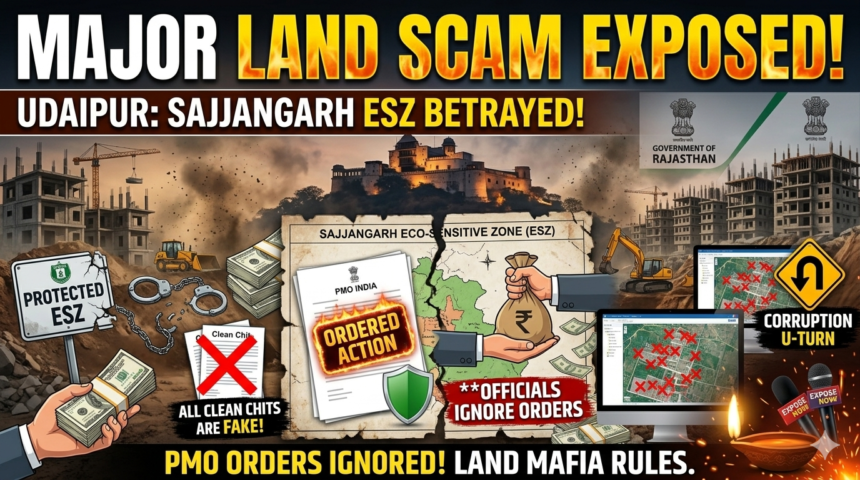
Udaipur, Rajasthan – A major environmental corruption case involving nearly ₹300 crore in illegal land and construction violations in the Sajjangarh Eco‑Sensitive Zone (ESZ) has come under intense scrutiny after the Prime Minister’s Office (PMO) instructed strict action. However, reports indicate that local authorities and officials have largely ignored the PMO’s directives and appear to be protecting violators rather than taking corrective measures.
The controversy centers around alleged collusion between the Udaipur Development Authority (UDA) and officers from the Forest Department. Investigators and local activists claim that environmental norms designed to protect the eco‑sensitive buffer around the world‑famous Sajjangarh Biological Park were deliberately bypassed to enable unauthorized construction and land conversions.
📌 PMO Intervention and Continued Violations
Complaints about illegal development and misuse of protected ESZ land prompted intervention from the PMO, which directed the Udaipur District Collector and the Principal Chief Conservator of Forests to take firm action against those responsible. Yet, according to the Expose Now report, officials have instead tampered with official site measurements and altered distance records to make restricted land appear compliant, thereby justifying approvals that should never have been granted.
🏗️ Large‑Scale Rule Breaches
The report highlights several disturbing irregularities in the contested development:
- Boundary Manipulation: Land legally within the prohibited 1 km buffer zone was documented on paper as being outside restricted areas, allowing approvals to proceed.
- Unauthorized Expansion: While permission was granted for a two‑storey (G + 2) building, a four‑storey structure (G + 4) has already been constructed, exceeding allowed height norms.
- Area Violation: The sanctioned built‑up area was only 96,000 sq ft, but actual construction now covers more than 400,000 sq ft, a significant breach of ESZ regulations.
🌳 Environmental Rules and Supreme Court Orders Ignored
The alleged misconduct goes beyond local statutes, with the report suggesting that officials also failed to uphold Supreme Court directives aimed at safeguarding eco‑sensitive zones and forest boundaries. These directives are meant to strictly regulate commercial and structural development within protected natural areas, and violations have raised alarm among environmentalists and citizens alike.
More Read

📣 Public Concern and Demand for Accountability
Environmental groups and local residents have criticized the apparent inaction by the authorities despite the PMO’s orders. Many fear this case reflects a larger trend of administrative laxity and complicity in environmental degradation, with public funds and protected ecosystems bearing the brunt of such governance failures.