

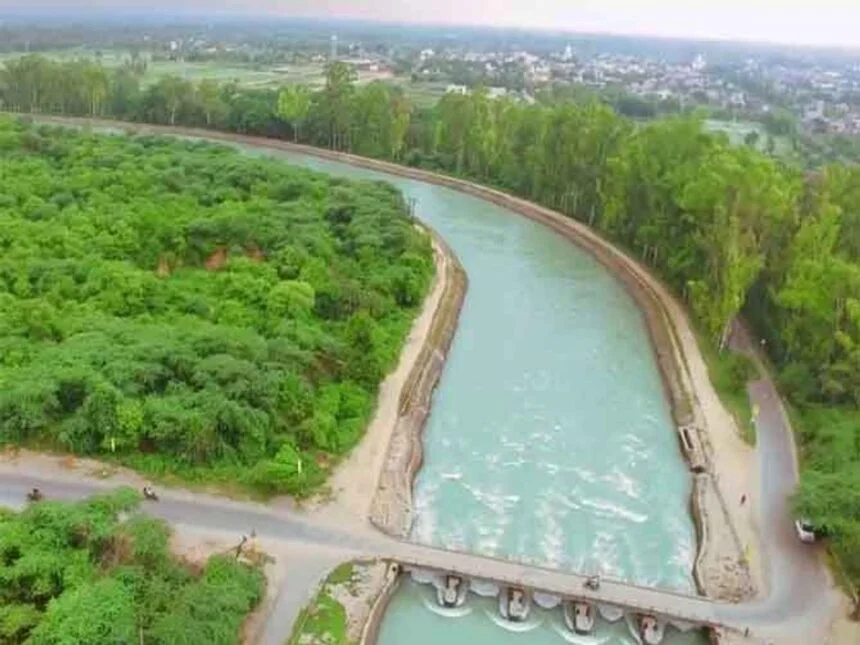
Bikaner: A major financial irregularity has surfaced in Rajasthan’s prestigious Indira Gandhi Canal Project (IGNP), often referred to as the lifeline of the desert state. A recent audit conducted by the office of the Accountant General has exposed alleged large-scale manipulation in tender allocation, questionable financial decisions, and serious procedural violations that reportedly caused losses worth crores to the state exchequer.
The audit findings, reviewed by Expose Now, indicate how rules were allegedly bent to favour selected contractors while causing significant financial damage to the government and hardship to farmers.
The audit covered works executed between April 2022 and March 2025 and was conducted by a committee comprising Assistant Audit Officers Rameshchandra Mahawar, Praveen Tanwar and Assistant Supervisor Basant Ballabh Panda.
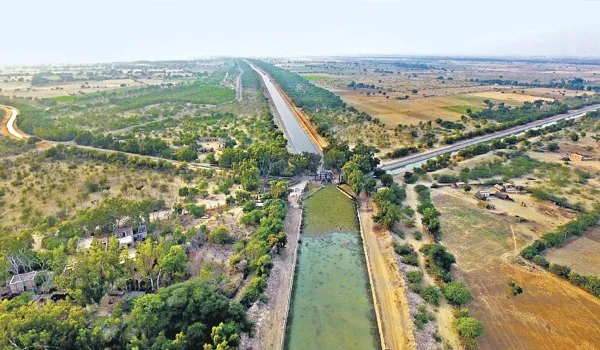
Cheap Contractor Removed, Costlier Tender Approved
The controversy revolves around a project for the construction of irrigation ponds, locally known as “Diggis,” sanctioned at an estimated cost of ₹216.60 crore.
Initially, the contract was awarded to LC Infra, which quoted rates 9.63% lower than the estimated cost and agreed to execute the project for around ₹193.75 crore.
More Read

The company had already completed construction of 136 out of the proposed 249 diggis covering more than 48,000 hectares when the department abruptly cancelled the remaining work in May 2022, citing “lack of budget.”
However, the audit report contradicted the department’s claim.
According to audit records, the Kolayat division had more than ₹790 crore available during that period, and even after expenditure, over ₹403 crore remained unused.
More Read

Despite this, the remaining work was cancelled and, after about nine months, re-awarded to Gopi Krishna Infrastructure Private Limited at substantially higher rates.
The audit concluded that this decision caused an additional financial burden of ₹33.95 crore on the government.
Department’s Defense Raises Further Questions
Responding to the allegations, Vivek Goyal argued that the project was jointly funded by the Centre and the State on a 50:50 basis and that the Central Government had discontinued the CADWM scheme soon after the work order was issued.
According to him, the state halted the work after central funding stopped and later decided to complete the remaining portion through a fresh tender process.
He claimed that naturally, rates for the remaining work became higher.
However, auditors reportedly noted that no formal correspondence seeking additional funds from the Centre was found on record, despite the department publicly citing budget shortages.
More Read


Additional ₹8.32 Crore Allegedly Paid by Manipulating Billing Rules
The audit report also highlighted irregularities in contractor payments.
Since LC Infra had secured the project at 9.63% below estimated rates, corresponding deductions were supposed to be applied to all bills.
While the first 14 bills followed the rule, the remaining 20 bills reportedly saw deductions reduced drastically to only 0.891%.
This alteration allegedly resulted in excess payments of ₹8.32 crore to the contractor.
Defending the decision, Chief Engineer Vivek Goyal stated that the project was based on item-rate contracts and some construction materials became costlier during execution.
He claimed that concessions were granted to the contractor during negotiations due to increased costs.
However, the audit team reportedly rejected this explanation and recommended recovery of the excess amount in September 2025.
Power Connections Missing Despite ₹25.78 Crore Payment
Another major irregularity concerns electricity infrastructure linked to the irrigation project.
Under the scheme, power connections were essential for operating drip irrigation systems connected to the diggis.
The project timeline required all such infrastructure to be completed by 2019.
Records show that ₹25.78 crore was deposited with the discom in 2022 for electrification work.
Yet, by September 2025, several diggis reportedly remained without functional electricity connections.
Ground verification in villages such as Randheesar allegedly revealed incomplete infrastructure, including damaged motors, broken pipelines, tilted electric poles, and missing wires despite claims of project completion on paper.
When questioned, Chief Engineer Vivek Goyal maintained that the discom had laid transmission lines and was continuing connection work.
Farmers Allege Illegal Construction on Fertile Land
The audit and field reports also exposed allegations that contractors ignored approved survey locations and constructed diggis on fertile agricultural land without consent from farmers.
Case of Gopal Singh Solanki
Farmer Gopal Singh Solanki alleged that the survey designated construction on Khasra No. 3/6, but the contractor instead shifted the diggi to his land on Khasra No. 6/7 to save money.
He claimed the move destroyed nearly eight bighas of fertile farmland.
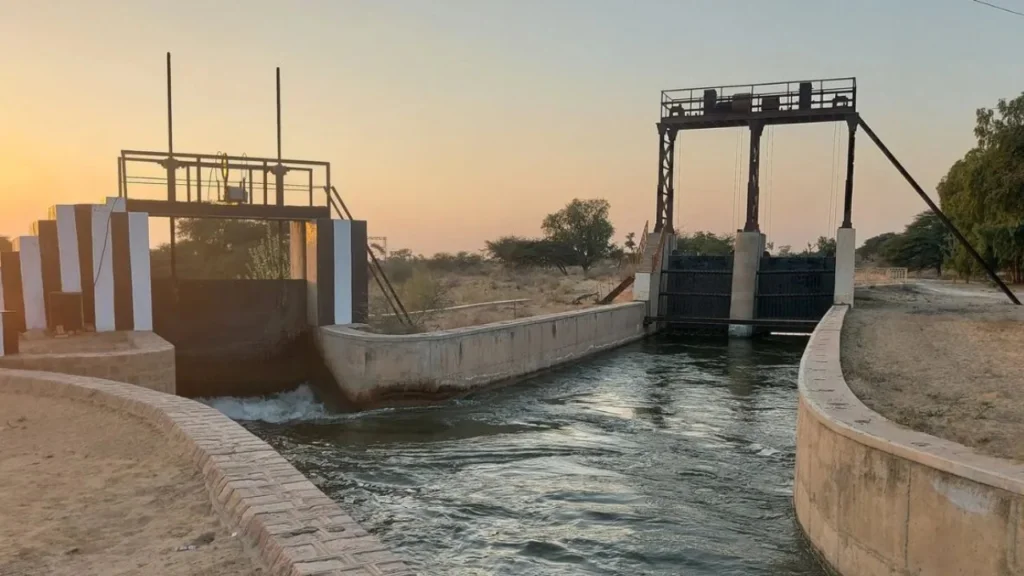
Complaint by Satyanarayan of Randheesar
Another farmer, Satyanarayan, alleged that construction was shifted from Khasra No. 49/9 to his field on Khasra No. 49/8, damaging around eight bighas of productive land.
Maintenance Advance Paid Before Completion of Project
In another questionable decision, contractor firm Lakshmi Firm reportedly received an advance maintenance payment of ₹3.60 crore even though the project itself remained incomplete.
Ground inspections reportedly found damaged pipelines, broken water storage structures, and non-functional electrical systems at multiple locations.
The department defended the payment by stating that electricity supply delays prevented operation of the system and therefore certain tender conditions were relaxed.
However, auditors questioned how lower-level officials altered conditions originally approved by the empowered committee of the Indira Gandhi Canal Board.
Farmer Union Alleges Nexus Between Officials and Contractors
Reacting strongly to the findings, Shambhu Singh accused officials and contractors of colluding to execute poor-quality construction.
He alleged that electricity connections promised by 2019 are still unavailable and several diggis are deteriorating before even becoming operational.
Audit Timeline and Findings
The audit of the Kolayat Lift Division under the Indira Gandhi Canal Project was conducted from August 18 to September 9, 2025.
The report has intensified demands for an independent investigation into alleged corruption, tender manipulation, financial irregularities, and negligence affecting both public funds and farmers.
Observers believe the revelations may trigger administrative scrutiny and possible accountability proceedings against officials involved in project execution and financial approvals.