

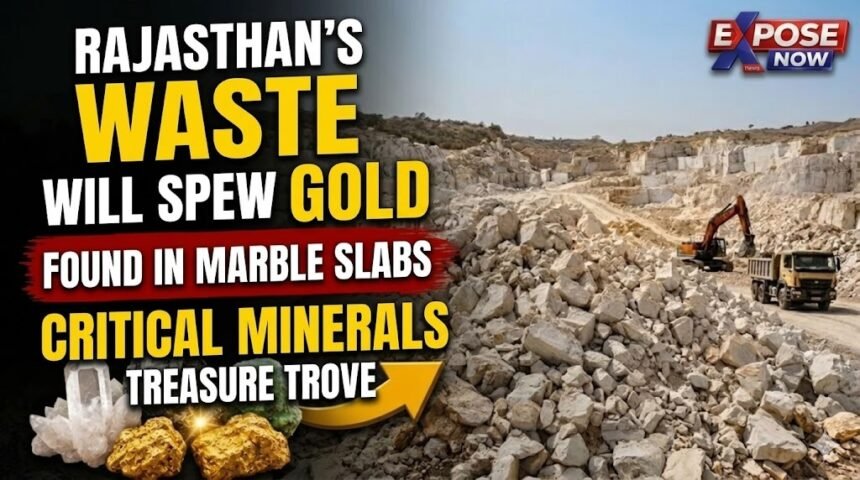
Jaipur, Rajasthan: In a breakthrough that could transform the state’s mining sector, Rajasthan has discovered promising concentrations of critical minerals, including nickel, cobalt, chromium and gallium, in marble waste dumps that were previously considered industrial waste. The findings have prompted the state government to expand scientific exploration of mining debris across multiple districts. Recent assessments indicate that some of these minerals are present in concentrations significantly higher than their average occurrence in the Earth’s crust.
IIT Dhanbad and RSMET Join Hands for Scientific Assessment
To unlock the commercial potential of these resources, the Rajasthan State Mines and Minerals Exploration Trust (RSMET) has entered into a collaboration with IIT (ISM) Dhanbad. The partnership will focus on scientific evaluation, mineralogical analysis, extraction studies and feasibility assessments aimed at determining whether these critical minerals can be commercially recovered from mine waste and tailings.
Pilot Project Reveals Encouraging Results
As part of a pilot initiative, authorities identified 78 mining waste dumps across Rajasthan and grouped them into clusters for detailed study. One cluster comprising eight pink marble dumps and two green marble (serpentinite) dumps in and around Udaipur was examined in detail.
According to officials, the assessment revealed notable quantities of nickel, cobalt, chromium and gallium. Preliminary estimates suggest that the concentration of these minerals in the studied dumps is approximately 25 to 40 times higher than their average abundance in the Earth’s crust, raising hopes of commercially viable extraction in the future.
Survey Expanded Across Multiple Districts
Following the encouraging findings, the state has initiated a broader assessment of the remaining mining dumps and tailings. The exercise includes geo-referenced mapping, sampling, mineralogical analysis, extraction studies and resource estimation.
More Read

The identified dumps are spread across several districts, including Udaipur, Banswara, Dungarpur, Pratapgarh, Salumber, Ajmer, Nagaur, Sirohi, Jodhpur and Jalore. Officials are also exploring the possibility of finding additional critical minerals such as lithium, tungsten and rare earth elements in these deposits.
Strategic Importance for India’s Energy and Defence Sectors
Critical minerals such as nickel, cobalt and rare earth elements are essential for manufacturing electric vehicle batteries, renewable energy equipment, aerospace systems, defence technologies and advanced electronics. India currently relies heavily on imports for many of these minerals, making domestic discoveries strategically important.
The Rajasthan initiative aligns with the National Critical Mineral Mission, which seeks to strengthen India’s resource security and reduce dependence on overseas supply chains for strategically important minerals.
More Read

Mining Waste Could Become Economic Asset
Experts believe the project could turn decades-old mining waste dumps into valuable economic resources while simultaneously addressing environmental concerns associated with waste accumulation. By extracting critical minerals from existing dumps, Rajasthan could generate additional revenue, reduce mining waste and contribute to India’s transition towards sustainable and resource-efficient mining practices.
Rajasthan Strengthens Position in Critical Minerals Sector
The latest discovery comes as Rajasthan emerges as one of India’s key regions for critical mineral exploration. Officials believe that continued scientific assessment and technological support from premier institutions such as IIT Dhanbad could help the state become a major contributor to India’s critical minerals supply chain in the coming years.
With global demand for battery metals and strategic minerals rising rapidly, the successful recovery of valuable resources from mining waste could position Rajasthan at the forefront of India’s mineral security strategy.