

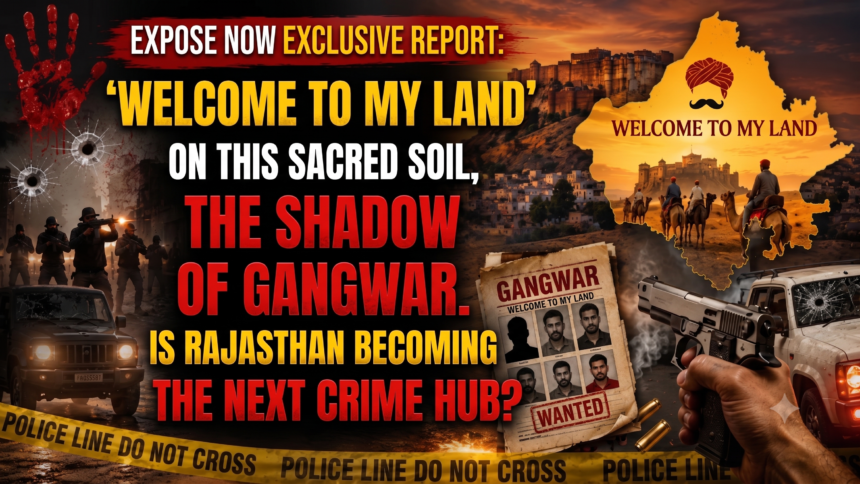
Special Report | Organised Crime, Gang Rivalries and the Growing Challenge for Rajasthan Police
Rajasthan, widely known for its rich heritage, tourism and cultural identity, is increasingly facing a serious internal security challenge as organised criminal networks, gang rivalries, extortion and targeted killings continue to raise concerns across the state.
The emergence of powerful criminal syndicates and violent gang rivalries has created a new security landscape for law enforcement agencies. In recent years, incidents linked to gang conflicts have repeatedly made headlines, raising questions over whether Rajasthan is witnessing the gradual transformation of local criminal groups into sophisticated organised crime networks with links extending beyond state borders.
The situation has become particularly concerning because several criminal networks are no longer restricted to traditional local disputes. Their activities have increasingly involved alleged extortion, contract killings, illegal arms, threats and the use of social media to project influence and intimidate rivals.
Gang Rivalries Becoming a Major Law-and-Order Challenge
Rajasthan has witnessed a series of violent incidents in which rival criminal groups have allegedly targeted one another. The pattern suggests that gang conflicts are no longer isolated incidents but part of a wider ecosystem of organised crime.
More Read

The growing influence of criminal groups has also raised concerns about the use of technology and social media. Gangsters and their associates have increasingly used digital platforms to claim responsibility for crimes, issue threats and create an image of power among supporters and potential recruits.
Such activities can have a multiplier effect. A single incident of violence can trigger retaliation, leading to a chain of attacks between rival groups.
The challenge for the police is therefore not limited to investigating individual crimes. Authorities have to identify the broader network behind these incidents, track financial resources, monitor arms supply chains and prevent criminal groups from recruiting new members.
More Read

AGTF and SOG at the Centre of the Crackdown
In response to the growing threat from organised criminal networks, specialised police units such as the Anti-Gangster Task Force (AGTF) and the Special Operations Group (SOG) have assumed a crucial role in Rajasthan’s fight against gangsters.
The objective of such specialised operations is to move beyond conventional policing and target the entire criminal ecosystem. This includes identifying gang leaders, their associates, financiers, arms suppliers and individuals allegedly involved in providing logistical support.
The police strategy has increasingly focused on intelligence-based operations, coordinated raids, arrests and action against criminal networks operating across district and state boundaries.
The recent operations also underline an important shift in policing: organised crime cannot be tackled effectively through isolated district-level investigations alone. Criminal networks often operate across multiple jurisdictions, making coordination between state police forces and central agencies increasingly important.
The Lawrence Bishnoi Network and Inter-State Connections
One of the most prominent examples of the changing organised-crime landscape in North India is the alleged expansion of networks associated with the Lawrence Bishnoi gang.
Rajasthan’s geographical position, its proximity to Punjab and Haryana, and its extensive road network have made the state strategically important in the movement and activities of criminal networks operating across northern India.
More Read

Recent police actions have also highlighted the interstate nature of such criminal operations. In July 2026, a coordinated operation involving the Rajasthan Police’s Anti-Gangster Task Force, Hanumangarh Police, District Special Team and Pune Police led to the arrest of three alleged associates of the Lawrence Bishnoi gang in connection with a reported extortion case involving a Pune businessman. The case demonstrated how criminal networks can operate across state boundaries and require coordinated action by multiple police forces.
The development is significant because it indicates that organised crime is increasingly becoming a multi-state challenge rather than a purely local law-and-order issue.
From Local Rivalries to Organised Crime Networks
The transformation of Rajasthan’s gang landscape can be understood through the evolution of criminal operations.
Earlier, gang rivalries were often linked to local disputes, property conflicts, political influence or personal enmity. However, the modern criminal ecosystem is more complex.
Today, criminal networks can potentially combine:
- Extortion and protection money
- Contract killings
- Illegal arms supply
- Drug trafficking
- Property-related criminal activities
- Threats to businessmen and public figures
- Cross-border and interstate criminal links
- Digital propaganda and social media intimidation
This evolution creates a major challenge for law enforcement because the traditional approach of arresting individual offenders may not be sufficient to dismantle an entire criminal network.
Why Rajasthan Is Vulnerable
Several factors make Rajasthan vulnerable to the expansion of organised criminal networks.
The state’s vast geographical area, long interstate boundaries and proximity to states such as Punjab, Haryana, Uttar Pradesh, Madhya Pradesh and Gujarat create multiple avenues for criminals to move and operate.
The state’s extensive highway network also provides connectivity between major urban centres and neighbouring states.
At the same time, Rajasthan’s growing economy, expanding cities and increasing business activity can create opportunities for organised criminal groups to target individuals and businesses through extortion and intimidation.
The challenge becomes even more complex when criminal networks establish local support systems, including hideouts, financial channels and associates who can assist in logistics.
The Social Media Factor
One of the most worrying developments is the increasing use of social media by criminal networks.
Criminal groups can use digital platforms to build a perception of fear and influence. Threat videos, photographs, messages and claims of responsibility can quickly reach thousands of people.
For law enforcement, this creates a new battlefield. Police agencies must not only investigate physical crimes but also monitor digital footprints, identify online associates and track communications that may be linked to criminal activities.
The social media presence of gangs can also have an impact on young people. The glorification of gangster culture can create a dangerous perception that criminal lifestyles are symbols of power, money or status.
Experts and law enforcement agencies therefore face the dual challenge of preventing crime while also countering the social influence and online image-building strategies of criminal groups.
The Question of Police Effectiveness
The intensified action by specialised units such as AGTF and SOG indicates that Rajasthan Police is attempting to respond aggressively to organised crime.
However, the continuing emergence of gang-related incidents raises an important question: Is enforcement alone enough?
Arrests and encounters may temporarily weaken criminal networks, but long-term success requires sustained action against the entire ecosystem that allows gangs to survive.
This includes:
- Strong intelligence gathering
- Effective witness protection
- Financial investigations
- Action against illegal arms networks
- Better interstate coordination
- Monitoring of criminal associates
- Faster prosecution of serious cases
- Action against illegal assets and money laundering
- Cyber monitoring of organised crime networks
Without addressing these factors, criminal groups can potentially reorganise after the arrest or death of their leaders.
Rajasthan at a Critical Crossroads
The question of whether Rajasthan is becoming the next major crime hub should not be answered solely on the basis of individual incidents. However, the repeated appearance of gang-related violence, interstate criminal connections and organised extortion networks is certainly a matter that demands serious attention.
The state has a long history of dealing with organised criminal figures and gang rivalries. The rise of new networks, however, suggests that the nature of the threat is evolving.
The challenge before Rajasthan Police is now to ensure that the state does not become a safe operating zone for criminal syndicates that use its territory, infrastructure and local networks to expand their operations.
The intensified role of AGTF and SOG is an important step, but the larger battle will depend on whether authorities can dismantle the financial, logistical and digital ecosystem supporting organised crime.
For Rajasthan, the issue is no longer simply about individual gangsters. It is about preventing the emergence of an organised crime infrastructure capable of surviving beyond individual arrests.
The coming years will determine whether Rajasthan can effectively contain this growing threat—or whether gang wars and organised crime will become a deeper and more permanent challenge to the state’s law-and-order machinery.