

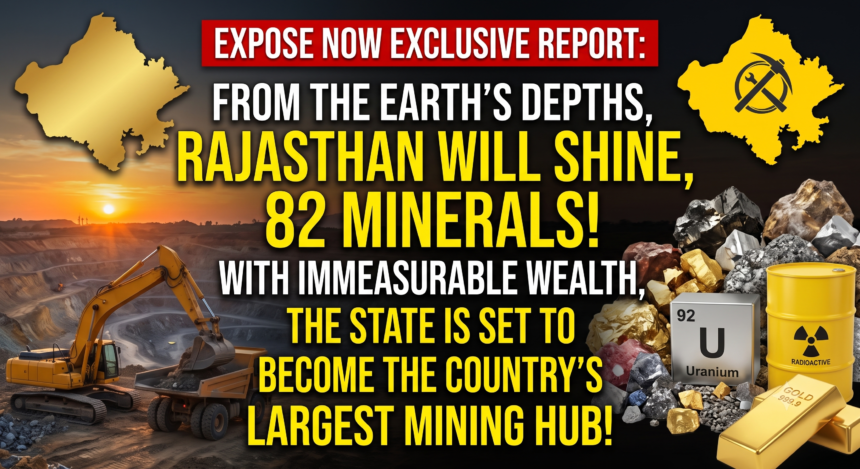
Special Report | Rajasthan’s vast mineral reserves are emerging as a major strategic opportunity, with gold, uranium, potash and critical minerals at the centre of renewed exploration and mining activity
Rajasthan, already recognised as one of India’s most mineral-rich states, is witnessing a renewed push to explore and develop its vast mineral resources. From gold and uranium to potash, limestone, copper and critical minerals, the state is increasingly emerging as a strategically important destination for India’s mining and mineral security ambitions.
With extensive geological diversity and deposits spread across different regions, Rajasthan has the potential to strengthen India’s domestic supply of several important minerals while generating investment, employment and state revenue.
The state’s mineral potential is now receiving greater attention as the country seeks to reduce dependence on imports of critical and strategic resources. The focus is no longer limited to conventional minerals. Exploration programmes are increasingly targeting minerals that are considered essential for industries such as energy, defence, electronics, fertilisers, manufacturing and advanced technologies.
Rajasthan’s 82-Mineral Wealth: A Major Natural Advantage
Rajasthan’s mineral landscape is exceptionally diverse, with the state known for deposits of a wide range of metallic, non-metallic and industrial minerals.
More Read

The availability of a large number of mineral varieties has given Rajasthan a unique position in India’s mining sector. The state has historically been a major producer of minerals such as limestone, zinc, lead, silver, marble, sandstone and gypsum. The emerging focus on gold, uranium, potash and other strategic resources could further expand the state’s role in the national mineral economy.
The Department of Mines & Geology, Government of Rajasthan, continues to undertake exploration, auctions and regulatory activities related to the state’s mineral resources. Its current activities also include exploration-related tenders and auctions for minerals such as gypsum and bajri, underlining the scale of the state’s mining administration.
Gold Mining Opens a New Chapter for Rajasthan
Gold is among the most closely watched mineral resources in Rajasthan.
More Read

The Bhukia-Jagpura area of Banswara has emerged as a significant gold exploration and mining zone. Rajasthan’s entry into the gold-mining sector has generated considerable interest because of the potential economic value associated with the deposits.
However, the development of gold mining has also faced regulatory and procedural challenges. The auction of Rajasthan’s first gold mine was cancelled after discrepancies were reportedly found in documents submitted by the successful bidder, highlighting the importance of due diligence and transparent procedures in the allocation of mineral resources.
At the same time, additional gold-bearing blocks in the state have attracted attention. Proposed mining activity in the Aravalli region, however, has faced legal and environmental uncertainty following restrictions affecting new mining leases in the range. This means Rajasthan’s gold story is promising but will depend on regulatory approvals, environmental safeguards, transparent auctions and the successful transition from exploration to commercial production.
Uranium: Rajasthan’s Strategic Mineral Potential
Uranium is perhaps the most strategically important mineral in Rajasthan’s emerging mining story. The Atomic Minerals Directorate for Exploration and Research (AMD), under the Department of Atomic Energy, has identified uranium deposits in Sikar district.
The Rohil Uranium Deposit has been formally recognised for development, with the Uranium Corporation of India Limited (UCIL) nominated as the prospective lessee for the mining lease. The Union government stated in February 2026 that statutory clearances were being pursued before mining operations could begin. The development is significant because uranium is a critical resource for India’s nuclear energy programme. If mining operations eventually commence following the completion of all statutory requirements, Rajasthan could become an important contributor to India’s domestic uranium supply The uranium potential of the Sikar region also places Rajasthan at the centre of the country’s broader efforts to strengthen strategic mineral security.
Potash Could Reduce India’s Import Dependence
Another major mineral opportunity lies beneath Rajasthan’s Bikaner-Nagaur region, where potash resources have been identified. Potash is a key input for fertiliser production and therefore has direct implications for India’s agricultural economy and food security. India currently relies heavily on imports to meet its potash requirements. The development of domestic resources could therefore have strategic importance for the country’s agricultural sector.
More Read

The potential of Rajasthan’s potash resources has been recognised for several years. In 2021, the Mineral Exploration Corporation Limited (MECL), Rajasthan State Mines & Minerals Limited (RSMML) and the Rajasthan Department of Mines & Geology entered into a tripartite agreement to undertake feasibility studies for solution mining of potash. The initiative was described as a step towards establishing Rajasthan as a major hub for solution mining of potash.
The Bikaner-Nagaur belt continues to remain an important focus area in the state’s mineral exploration strategy.
Critical Minerals: The Next Big Opportunity
The importance of Rajasthan’s mineral resources extends beyond traditional mining. Critical and strategic minerals are becoming increasingly important for India’s economic and national security priorities. These resources are essential for sectors including renewable energy, electric vehicles, batteries, semiconductors, electronics, aerospace and defence. Rajasthan is now seeking to expand exploration for such minerals.
A recent state-level exploration programme has identified areas including the Siwana Ring for critical minerals, Rohil in Sikar for uranium, Banswara for gold and iron minerals, and the Bikaner-Nagaur belt for potash. The programme reflects the growing emphasis on discovering and developing resources that could reduce India’s dependence on overseas supplies. The expansion of exploration activities could potentially place Rajasthan in a stronger position in India’s emerging critical-mineral supply chain.
Potential Economic Impact
The expansion of mining activity could have a significant economic impact on Rajasthan. Large-scale mining projects typically create employment opportunities not only within mines but also across transportation, construction, equipment supply, processing, logistics and allied industries. Gold, uranium and potash projects, if successfully developed, could generate new economic activity in mineral-rich districts.
The downstream impact could be equally important. Establishing mineral-processing and value-addition industries within the state could help Rajasthan move beyond being merely a supplier of raw materials. For example, the development of processing facilities linked to critical minerals could create opportunities for manufacturing industries and technology-driven sectors.
This could potentially lead to the development of new mining clusters and industrial corridors around mineral-rich regions.
Revenue Opportunity for the State
The expansion of mining can also strengthen government revenues through royalties, premiums, auction proceeds and other associated payments. However, the actual financial benefits will depend on the commercial viability of individual deposits, the scale of recoverable resources, successful auctions and the commencement of production.
The state will also need to ensure that mining revenues are accompanied by investments in local infrastructure and community development. For mineral-rich districts, the challenge is to ensure that mining-led growth translates into tangible improvements in roads, healthcare, education, water infrastructure and employment opportunities.
Employment and Local Development
Mining expansion could potentially create thousands of direct and indirect employment opportunities. The impact would be particularly important in rural and economically developing areas where large mineral deposits are located. However, mining projects also bring social and environmental responsibilities.
Land acquisition, rehabilitation, groundwater management, ecological protection and community consent are among the critical issues that must be addressed before large-scale operations begin. A sustainable mining model will therefore be essential for ensuring that economic development does not come at the cost of environmental degradation or local livelihoods.
Environmental Challenges Cannot Be Ignored
Rajasthan’s mineral wealth comes with significant environmental challenges.The state is already one of India’s most water-stressed regions, making water-intensive mining activities particularly sensitive. Mining operations can affect groundwater, land quality and local ecosystems if not properly regulated.
The Aravalli region presents an additional challenge because of its ecological importance and the legal scrutiny surrounding mining activities. The future of Rajasthan’s mining sector will therefore depend on maintaining a balance between economic development and environmental protection. Strict compliance with environmental regulations, scientific mine planning, land restoration and responsible water management will be critical.
From Mineral-Rich State to Mining and Processing Hub?
The central question is whether Rajasthan can transform its mineral wealth into a long-term industrial advantage. The state already has a strong mining base, but the next phase could involve greater emphasis on exploration, processing and value addition. If gold, uranium and potash projects progress successfully, alongside the exploration of critical and strategic minerals, Rajasthan could strengthen its position in India’s mineral economy.
However, discovery alone does not automatically translate into commercial production. Mining projects require detailed exploration, feasibility studies, auctions or allocation procedures, environmental and forest clearances where applicable, land arrangements, infrastructure and regulatory approvals. The experience of gold-mining auctions and the continuing legal and environmental scrutiny of certain mining areas demonstrates that the path from mineral discovery to actual production can be long and complex.
The Road Ahead
Rajasthan is entering a potentially important phase in the development of its mineral economy. The combination of traditional mineral strength and new opportunities in gold, uranium, potash and critical minerals could significantly enhance the state’s strategic importance.
The discovery and development of uranium resources could support India’s nuclear ambitions. Potash could contribute to reducing fertiliser import dependence. Gold could open a new segment of the state’s mining economy, while critical-mineral exploration could support India’s broader industrial and technological ambitions. But the success of this mineral transformation will ultimately depend on three factors: transparent governance, sustainable mining and timely execution.
If exploration is followed by responsible development and value addition, Rajasthan could move beyond its traditional identity as a mineral-producing state and emerge as one of India’s most important mining and mineral-processing hubs. For Rajasthan, the mineral story is no longer simply about what lies beneath the ground. It is about whether the state can convert its vast geological wealth into employment, investment, industrial growth and strategic strength—while ensuring that the environment and local communities are protected.