

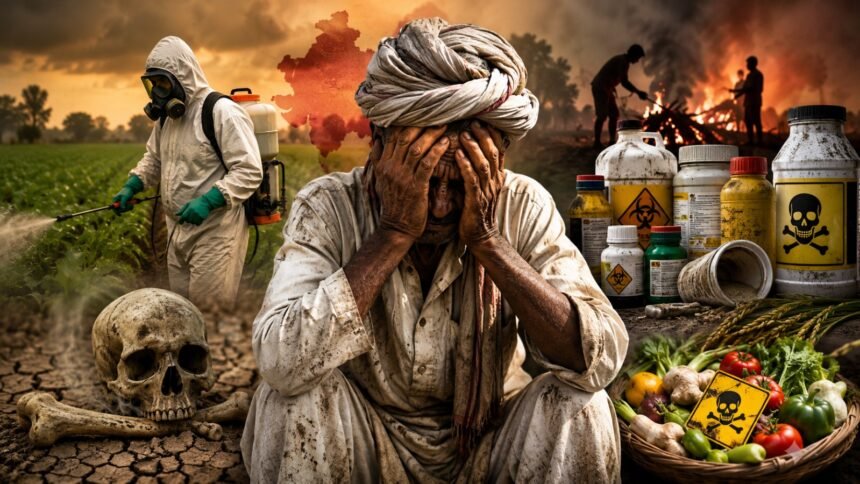
Rajasthan’s agricultural landscape is facing a disturbing and largely invisible crisis, with pesticide exposure emerging as a major threat to farmers and agricultural workers who rely on chemical sprays to protect their crops.
An investigative report by Expose Now has highlighted a staggering 1,383 deaths reportedly linked to pesticide exposure over a 36-month period, raising serious questions about the safety of chemical-intensive farming, awareness among farmers, the availability of protective equipment and the effectiveness of regulatory enforcement across the state.
The crisis is particularly concerning in major agricultural belts, including Bikaner, Hanumangarh, Churu and Sri Ganganagar, where farmers routinely work with pesticides in extreme weather conditions and often spray chemicals without adequate protective gear.
The issue is not simply about individual accidents. The scale of the reported deaths points towards a wider public health and agricultural safety challenge that requires urgent government attention.
Pesticides: A Silent Threat in Rajasthan’s Fields
Pesticides are widely used across Rajasthan to control insects, pests and crop diseases. However, unsafe handling, prolonged exposure and inadequate safety precautions can expose farmers and agricultural labourers to highly toxic chemicals.
More Read

Many farmers work for hours while spraying crops, often without masks, gloves, protective clothing or other safety equipment. In several cases, workers may also return to sprayed fields before it is safe to do so.
The danger can increase when pesticides are mixed incorrectly, used in excessive quantities or stored without proper precautions.
The reported deaths have therefore raised concerns over whether farmers are receiving adequate information about the chemicals they use and whether the existing system is doing enough to prevent pesticide poisoning.
More Read

Bikaner and Hanumangarh Face a Major Challenge
The agricultural districts of northern and western Rajasthan have emerged as areas of particular concern.
Bikaner has been identified among the worst-affected districts in available data. Recent Agriculture Department figures presented in the Rajasthan Assembly separately recorded 57 pesticide-exposure deaths in Bikaner between January 2024 and January 2026, the highest number among the districts listed in that dataset.
Hanumangarh recorded 42 deaths during the same period, while Churu reported 56. Jhalawar recorded 42 deaths, Jodhpur 38, and Sri Ganganagar and Beawar 31 each. The figures demonstrate the continuing seriousness of pesticide exposure across multiple agricultural regions of Rajasthan.
The presence of Bikaner and Hanumangarh among the most affected areas is particularly significant because these districts have substantial agricultural activity and large numbers of farmers and farm workers who regularly come into contact with crop-protection chemicals.
535 Deaths Recorded in Two Years
Government data presented in the Rajasthan Assembly provides another indication of the scale of the problem.
According to Agriculture Department information, 535 farmers died due to pesticide exposure while working in fields between January 2024 and January 2026. The government attributed such deaths to factors including failure to adopt necessary safety measures and the indiscriminate or unsafe use of pesticides.
More Read

During the same two-year period, the Rajasthan government reportedly provided around ₹5.1 crore in assistance to the families of deceased farmers under the Chief Minister’s farmer welfare scheme. However, the district-wise distribution of compensation varied, highlighting the need for greater transparency and examination of how compensation claims are processed.
These official figures and the broader 36-month dataset highlighted in the Expose Now investigation should be viewed as separate data points because they cover different periods and may use different criteria for recording pesticide-related deaths.
189 Pesticide Samples Found Substandard
The crisis becomes even more serious when the quality of pesticides available in the market is considered.
According to Agriculture Department data cited in recent reports, 189 pesticide samples were found to be substandard during quality checks conducted between January 2024 and January 2026.
The discovery raises questions about the quality-control system governing agricultural chemicals and the effectiveness of inspections carried out by authorities.
For farmers, the consequences of substandard pesticides can be significant. Such products may fail to control pests effectively, potentially encouraging repeated applications or higher doses. At the same time, farmers may face financial losses because of ineffective products while continuing to be exposed to chemical substances.
The findings underline the need for stronger testing mechanisms, regular market inspections and strict action against manufacturers or suppliers found violating quality standards.
The Human Cost Behind the Numbers
Every number in the death statistics represents a family affected by the loss of a breadwinner.
For farming households, the death or serious illness of an experienced farmer can have consequences far beyond immediate medical expenses. Families may lose their primary source of income, children may face disruptions in education and households can become trapped in debt.
The crisis also affects agricultural labourers, who frequently work with pesticides but may have even less access to safety information, protective equipment and healthcare.
The issue therefore needs to be addressed as both an agricultural and public health emergency.
Why Are Farmers at Risk?
Several factors can contribute to pesticide-related illness and deaths:
- Lack of protective masks, gloves and clothing
- Insufficient awareness about pesticide toxicity
- Incorrect mixing and excessive use of chemicals
- Inadequate training in safe spraying practices
- Poor storage and handling of pesticide containers
- Re-entry into fields soon after spraying
- Weak enforcement of safety regulations
- Availability of substandard or potentially unsafe products
- Limited access to immediate medical treatment in rural areas
The problem is further complicated by the fact that symptoms of pesticide poisoning may sometimes be mistaken for other illnesses, delaying diagnosis and treatment.
A Regulatory Failure That Needs Urgent Attention?
The scale of the reported deaths and the discovery of substandard pesticide samples raise a fundamental question: Is the existing regulatory framework strong enough to protect Rajasthan’s farmers?
Authorities need to examine the entire pesticide supply chain—from manufacturing and licensing to retail sales, field-level usage and post-exposure medical treatment.
Regular testing of pesticide samples should be strengthened, while retailers and distributors should be monitored to ensure that only approved and quality-certified products reach farmers.
At the same time, farmers must receive practical training in their own language on pesticide labels, dosage, mixing procedures, protective equipment and emergency response.
The Way Forward
Experts and farmer organisations have repeatedly stressed the importance of reducing unnecessary chemical exposure and promoting safer agricultural practices.
The government could consider expanding village-level awareness campaigns, providing affordable protective equipment, conducting regular health screenings for high-risk agricultural workers and ensuring rapid access to treatment in cases of suspected poisoning.
Agriculture officials should also intensify inspections of pesticide dealers and manufacturers, especially in districts reporting high numbers of deaths.
The reported 1,383 deaths over 36 months, together with the 535 deaths recorded in official data for January 2024-January 2026, presents a disturbing picture that cannot be ignored. While the datasets cover different periods and should not be directly combined without verification, both point to the same underlying concern: pesticide exposure is becoming a serious occupational and public health threat for Rajasthan’s farming community.
For a state whose economy and social fabric remain deeply connected to agriculture, protecting farmers from toxic chemical exposure must become a priority. The question is no longer simply how to protect crops from pests—it is how to protect the people who grow the food from the chemicals they use to produce it.
The pesticide crisis demands stronger enforcement, better-quality control, farmer education, protective equipment and a transparent system for recording deaths and providing compensation. Without immediate action, the silent toll of chemical exposure could continue to rise across Rajasthan’s fields.