

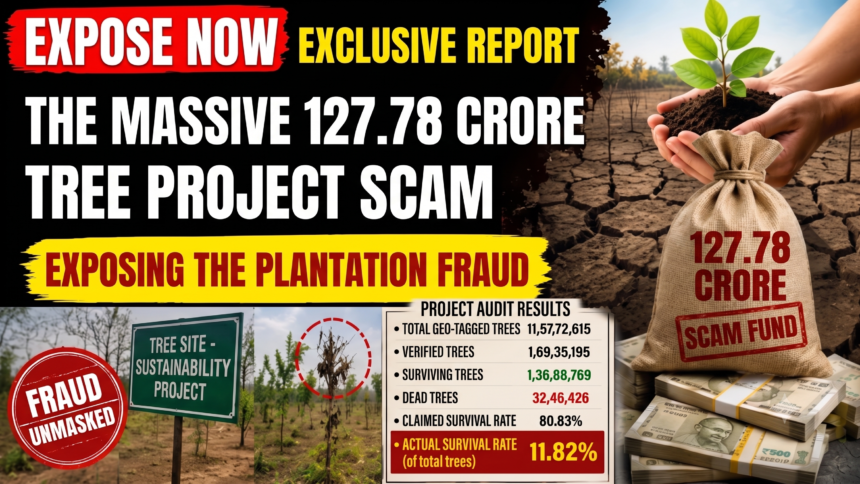
A major controversy has emerged over Rajasthan’s large-scale plantation campaign after official geo-tagging data allegedly revealed a massive gap between the number of saplings claimed to have been planted and those verified as surviving. The figures have triggered questions about the effectiveness of public spending, monitoring mechanisms, and the transparency of one of the state’s biggest environmental initiatives.
The plantation drive, which involved an expenditure of approximately ₹127.78 crore, recorded 11.57 crore geo-tagged saplings on government records. However, verification data reportedly indicates that only 1.69 crore saplings were authenticated, while merely 1.36 crore were found alive, raising concerns about the fate of nearly 10 crore saplings claimed in official records. The controversy comes amid broader scrutiny of plantation monitoring in Rajasthan.
Huge Gap Between Plantation Claims and Verified Survival
According to the available figures:
- Total geo-tagged saplings: 11,57,72,615
- Verified saplings: 1,69,35,195
- Living saplings: 1,36,88,769
- Dead saplings: 32,46,426
These numbers indicate that only a small proportion of the geo-tagged plantation data has been physically verified, while the actual survival count is substantially lower than the total plantation claims.
The discrepancy has prompted demands for a comprehensive audit to determine whether the difference resulted from poor survival rates, inadequate maintenance, incorrect reporting, or flaws in the geo-tagging and verification process.
More Read

₹127.78 Crore Spent on Plantation Programme
The plantation campaign was implemented under Rajasthan’s large-scale afforestation initiatives with an estimated expenditure of ₹127.78 crore.
Government departments, educational institutions, local bodies, and various agencies participated in the campaign, while geo-tagging technology was introduced to improve transparency and enable digital monitoring of plantations.
Officials had promoted geo-tagging as a tool to eliminate false reporting by linking every sapling with GPS coordinates and photographic evidence. Later, the state also mandated periodic photographic updates for every geo-tagged plantation to improve monitoring.
More Read

Geo-Tagging Intended to Ensure Accountability
The geo-tagging system was designed to record:
- GPS location of every plantation
- Photographic evidence
- Plantation date
- Department responsible
- Survival monitoring through periodic updates
The objective was to create a transparent digital database that could track plantations over several years instead of relying only on paper records.
However, the latest figures have sparked debate over whether geo-tagging alone is sufficient without rigorous field verification.
Questions Raised Over Verification Process
The reported data has led to several key questions:
- Were all geo-tagged plantations physically inspected?
- Why is there such a wide gap between geo-tagged and verified saplings?
- Was maintenance carried out after plantation?
- Were replacement plantations conducted where saplings died?
- Has the expenditure been independently audited?
Environmental experts say plantation success should be measured by long-term survival rather than the number of saplings planted during a campaign.
Plantation Monitoring Under Increased Scrutiny
The controversy comes at a time when plantation programmes in Rajasthan have already faced scrutiny in other cases. Recent investigations and reports have highlighted concerns over plantation quality, survival rates, and alleged irregularities in afforestation projects, leading to demands for stronger accountability and independent verification.
More Read

Experts argue that successful afforestation requires not only planting saplings but also sustained maintenance, watering, protection from grazing, and periodic survival audits over several years.
Need for Independent Audit
Transparency advocates have called for an independent technical audit of the plantation programme to verify:
- Actual number of surviving trees
- Accuracy of geo-tagged records
- Department-wise plantation performance
- Financial utilisation
- Long-term ecological impact
They believe that modern technologies such as satellite imagery, drone mapping, GIS-based monitoring, and third-party verification could strengthen public confidence in future plantation campaigns.
As Rajasthan continues to pursue ambitious environmental targets, the reported discrepancy between plantation claims and verified survival has intensified the debate over accountability, monitoring standards, and effective utilisation of public funds.