

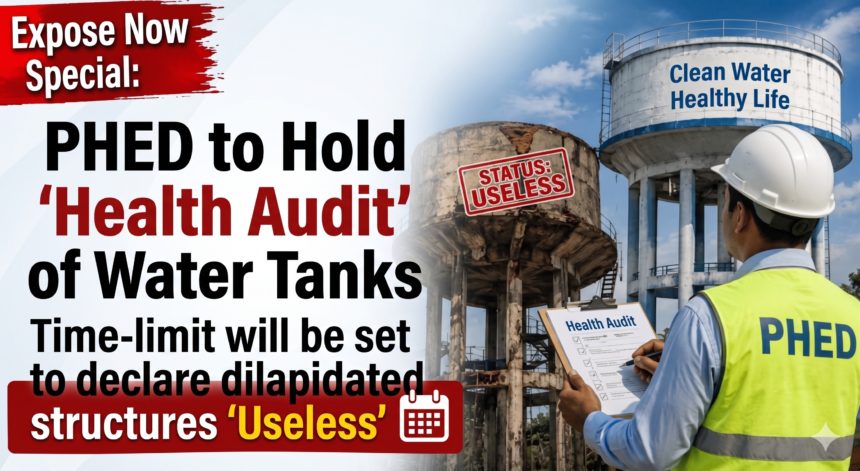
Jaipur: Concerns over drinking water safety in Rajasthan have intensified after demands were raised for a comprehensive health audit of water tanks managed under the state’s Public Health Engineering Department (PHED). The issue has sparked debate over the condition, maintenance, and water quality standards of storage infrastructure supplying drinking water across urban and rural regions.
The demand comes at a time when several citizens across Rajasthan have repeatedly reported issues related to contaminated water supply, poor maintenance of storage tanks, pipeline leakages, and irregular water distribution. Residents in multiple districts have alleged that aging water tanks and inadequate cleaning mechanisms may pose serious health risks, especially during the summer season when water demand rises sharply.
The PHED, which is responsible for providing potable drinking water throughout Rajasthan, operates an extensive network of pipelines, reservoirs, and storage tanks across the state. The department has acknowledged the challenges posed by declining groundwater levels, erratic rainfall, and water quality concerns including salinity and fluoride contamination.
According to officials and experts familiar with the issue, a health audit would involve inspection of structural conditions, water contamination risks, cleaning schedules, storage hygiene, and monitoring systems of overhead and underground water tanks. Such an audit could also help identify areas where sewage mixing, bacterial contamination, or leakage issues may be affecting public health.
Recent public complaints shared on online forums and citizen platforms have highlighted recurring concerns about poor water quality and irregular supply in parts of Jaipur and other cities. Residents have reported low pressure supply, foul-smelling water, possible contamination, and increasing dependence on private water tankers during shortages.
More Read

The Rajasthan PHED has already introduced digital monitoring systems, GIS-based infrastructure management, and quality assurance mechanisms aimed at improving water supply operations. The department maintains that it is working toward safer and sustainable water delivery through modernization and surface water-based schemes.
Experts believe that periodic health audits of water tanks are essential in a state like Rajasthan, where climatic conditions and water scarcity place additional stress on public water infrastructure. Public health specialists have also emphasized that unclean storage tanks can become breeding grounds for bacteria and waterborne diseases if regular sanitization and testing are not ensured.
The issue has gained significance as summer temperatures continue to rise across Rajasthan, increasing the burden on the state’s already stretched water infrastructure. Citizens and social groups are now urging authorities to ensure transparency, regular inspections, and timely maintenance to safeguard public health.