

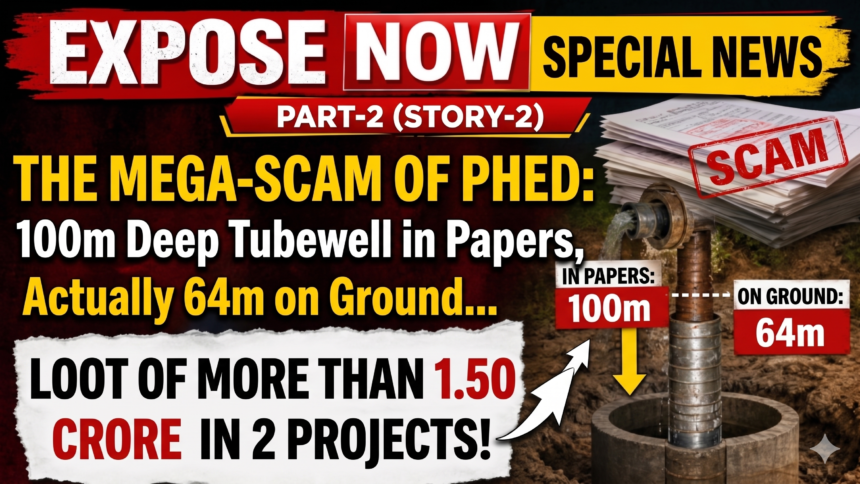
Jaipur : A fresh corruption controversy has emerged from Rajasthan’s Public Health Engineering Department (PHED), with serious allegations of financial irregularities and manipulation in the Bakawada water supply scheme. The expose highlights discrepancies between official records and on-ground execution, raising concerns over misuse of public funds in rural drinking water projects.
According to the report published by Expose Now, the scam revolves around the construction of tubewells under a government water scheme, where key project details appear to have been falsified in official documents.
Alleged Manipulation in Tubewell Depth
The investigation claims that while official records show tubewells drilled to depths of around 100 meters, the actual depth on the ground is reportedly much less—around 60–65 meters. Such discrepancies suggest that measurements recorded in official documents, particularly the Measurement Book (MB), may have been manipulated to inflate work completion and justify higher payments.
Measurement Books are crucial documents used to certify work completion and release payments. Any falsification in these records directly impacts government expenditure and accountability.
Inflated Billing and Misclassification
The expose further alleges that ordinary soil conditions were falsely classified as “hard rock” in project records. Since drilling through hard rock is significantly more expensive, this misclassification could have been used to inflate project costs and siphon off public money.
More Read

This method of exaggerating technical difficulty to justify higher payments has been observed in other Jal Jeevan Mission-related irregularities as well, where fake documentation and inflated project estimates led to large-scale corruption.
Financial Irregularities and Suspected Loss
The report points to suspected financial irregularities running into crores of rupees across multiple works under the scheme. Payments were allegedly made based on inflated or incorrect data, despite incomplete or substandard execution on the ground.
Similar patterns of irregularities—such as fake measurements, substandard work, and collusion between contractors and officials—have already been documented in Rajasthan’s water supply projects under the Jal Jeevan Mission.
More Read

Pattern of Systemic Corruption
The Bakawada case appears to be part of a larger pattern of alleged corruption within PHED projects across Rajasthan. Investigations in recent years have revealed:
- Use of forged documents to secure contracts
- Manipulation of tender processes
- Payments for incomplete or poor-quality work
- Collusion between contractors and department officials
Authorities, including the Anti-Corruption Bureau (ACB) and Enforcement Directorate (ED), have already initiated multiple probes into similar cases, involving projects worth hundreds to thousands of crores.
Demand for Investigation
The revelations have intensified demands for a thorough and independent investigation into the Bakawada water scheme. Experts argue that accountability must be fixed not only on contractors but also on officials responsible for verification and payment approvals.
With rural drinking water projects directly impacting public health and welfare, any compromise in quality or transparency raises serious governance concerns.