
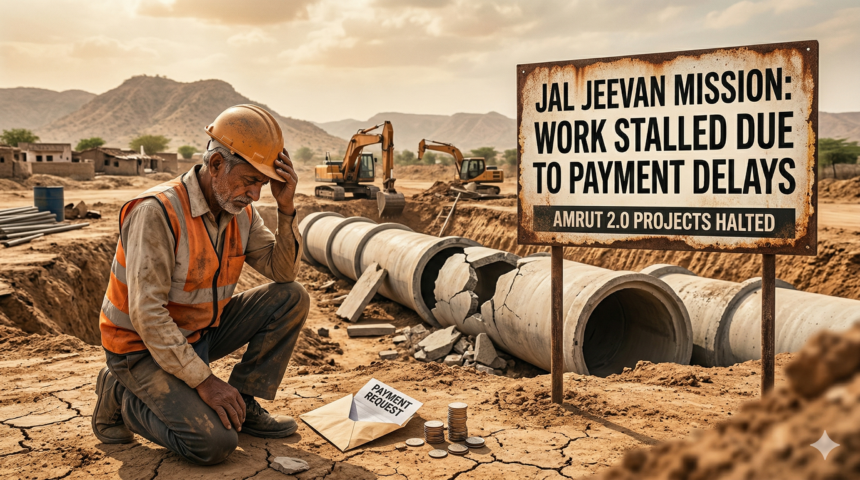
JAIPUR — Critical water infrastructure projects across Rajasthan are teetering on the edge of collapse as contractors face a severe liquidity crunch. Prolonged delays in fund disbursements under the Jal Jeevan Mission (JJM) and AMRUT 2.0 schemes have sparked a statewide financial crisis, affecting not only the firms involved but also thousands of daily-wage workers and the essential supply chain.
The Growing Debt: Payments Pending Since 2023
Despite the high-priority nature of these water projects, reports indicate that the government has failed to clear dues for an extended period. The backlog has reached a critical stage:
- Jal Jeevan Mission (JJM): Many contractors report that payments have been frozen since August 2023.
- AMRUT 2.0: Dues under this urban infrastructure scheme have remained unpaid since May 2025.
- Running Bills (RA): In several districts, essential running bills have been stuck in administrative limbo for over two to two-and-a-half years.
When funds are occasionally released, contractors describe them as “partial and irregular,” barely covering immediate operational costs.
Contractors Pushed Toward Insolvency
The financial strain has left many firms on the verge of default. Beyond the lack of income, contractors are being hit by secondary financial burdens:
- GST Liabilities: Contractors have already deposited GST on their invoices using personal funds or credit, yet the government has failed to provide the corresponding reimbursements.
- Mounting Interest: To keep projects moving, many have taken significant bank loans. With no incoming payments, interest is accumulating rapidly, creating a “debt trap.”
“We are paying interest on loans taken for government work while our own earned money is being withheld. It is an unsustainable situation that is pushing us toward financial ruin,” stated a representative from a local contractors’ association.
The Ripple Effect: Labour and Supply Chain Crisis
The payment vacuum is causing a catastrophic domino effect throughout the construction ecosystem:
More Read

- Unpaid Wages: Thousands of labourers and site employees are facing delayed salaries, leading to widespread distress among the workforce.
- Supply Chain Freeze: Suppliers have reportedly stopped providing raw materials—such as pipes, cement, and machinery—on credit due to the mounting unpaid balances.
- Subcontractor Losses: Smaller firms working under main contractors are unable to sustain operations, leading to a complete breakdown of the site-level hierarchy.
Infrastructure at Risk: A Threat to Public Services
With funds dried up, the physical progress of water projects has slowed to a crawl. In some regions, work has ground to a complete halt. This is particularly alarming given Rajasthan’s status as a water-scarce state.
The delay in JJM (rural drinking water) and AMRUT 2.0 (urban water systems) directly threatens the state’s ability to provide basic amenities to its citizens. If these projects remain stalled, the general public could face severe water shortages in the coming seasons.
Administrative Roadblocks and Demands
The national context suggests that fund disbursement has been tightened due to stricter monitoring and concerns over past irregularities. However, Rajasthan’s contractors argue that the current “blanket delay” is punishing honest firms.
More Read
The Contractors’ Demands:
- Immediate Clearance: The release of all pending payments up to the current date.
- GST Reimbursement: Urgent settlement of all GST-related dues.
- Transparency: The implementation of a time-bound, digital payment system to prevent future backlogs.
The Bottom Line: If the state government does not intervene immediately, the “Har Ghar Jal” dream may remain a distant reality for millions in Rajasthan as project execution faces a total shutdown.