

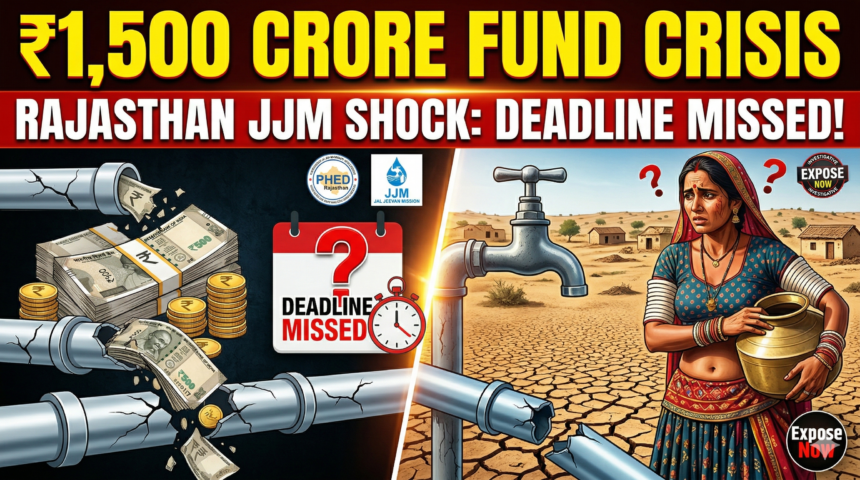
Jaipur, Rajasthan: The implementation of the Jal Jeevan Mission (JJM) in Rajasthan has run into a serious financial and administrative crisis, with officials reportedly missing a crucial ₹1,500 crore fund sanction deadline, raising fresh concerns about delivery of drinking water infrastructure and programme execution across the state.
Funding Bottlenecks Slow Project Execution
Sources familiar with state government and Public Health Engineering Department (PHED) operations indicate that timely release of central and state funds for JJM works has not occurred as scheduled, resulting in a cash crunch for ongoing rural water supply projects. The Jal Jeevan Mission, a flagship Government of India programme, aims to provide tap water connections to every rural household, and depends on matched funding releases from the Centre and state governments to meet financial commitments and contractor payments.
In many cases across the country, such funding delays have caused contractors to halt or slow work due to non‑payment of bills — a situation seen in other states where unpaid bills worth thousands of crores have stalled mission progress.
Officials within PHED have acknowledged that delays in fund transfers have hampered key project activities, including laying pipelines, installing pumping stations, and commissioning water supply systems in priority villages. These administrative delays compound existing technical and logistical challenges in arid districts such as Barmer, Jaisalmer and Balotra, where rural households still struggle to receive functional water connections despite official progress reports.
Missed Deadlines Add Pressure
The ₹1,500 crore funding shortfall — reportedly linked to missed deadlines for matching state shares required to trigger central releases — has placed additional pressure on PHED to maintain project momentum. Under JJM guidelines, states must release their share of funds before the Centre disburses the corresponding tranche; failure to do so can directly delay work orders and contractor payments.
More Read

Local contractors and engineers have privately expressed concern that such financial gaps stall ongoing work and erode contractor confidence, leading to slower physical progress on the ground and increasing the risk of further bottlenecks if payments are not regularised.
Public and Political Repercussions
The funding crisis has begun to affect public perception of the government’s ability to deliver essential services — especially as the region enters a season of heightened water demand due to rising temperatures. Reports suggest that rural areas are already experiencing intermittent water supply, with households forced to fetch water from alternative sources or wait extended periods between taps filling.
Meanwhile, state lawmakers and activists have criticised the handling of JJM funds, urging authorities to prioritise fund release and ensure transparent use of financial resources to prevent further delays in water supply infrastructure that millions of rural residents depend on.
More Read

Broader Jal Jeevan Mission Context
The Jal Jeevan Mission was launched by the Government of India in 2019 with the ambitious goal of delivering tap water connections to every rural home by 2024, although the deadline has since been extended to 2028 due to uneven progress across states. Rajasthan’s performance remains below targets despite significant fund inflows in other development sectors.
Experts note that efficient fund flows, accountability mechanisms, and performance monitoring are crucial to overcoming financial logjams and ensuring that rural households receive the basic necessity of reliable drinking water.