

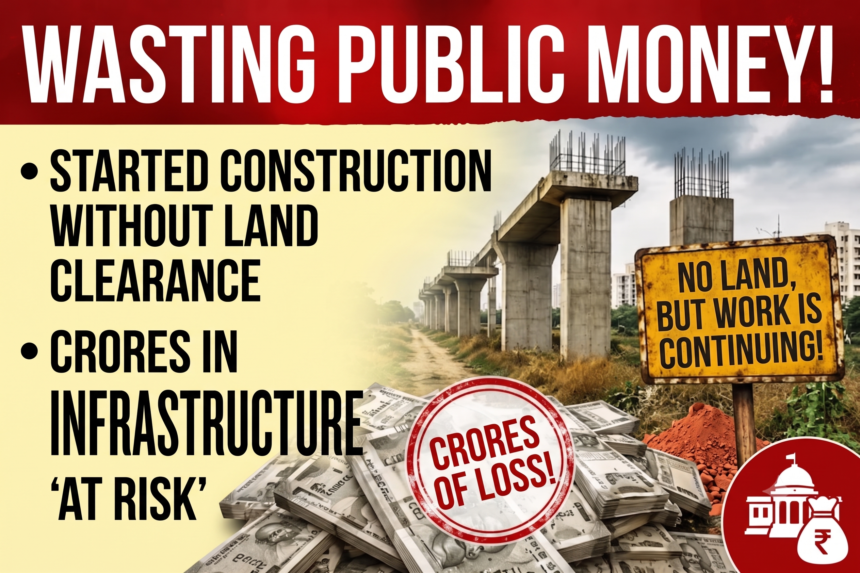
Jaipur : A major case of administrative negligence has surfaced in Rajasthan’s Public Health Engineering Department (PHED) under the Central Government’s ambitious Jal Jeevan Mission (JJM), raising serious questions over project planning and accountability. In Bharatpur division’s Nadbai block, officials allegedly started construction work for a multi-crore rural drinking water scheme without ensuring the availability of land, resulting in incomplete infrastructure and possible wastage of public funds worth crores of rupees.
The controversy pertains to a drinking water project worth more than Rs 43 crore aimed at providing Functional Household Tap Connections (FHTC) in 38 villages. Despite substantial expenditure and partial construction, residents of five villages are yet to receive even a single drop of water after nearly three years.
The PHED Finance Committee has now taken serious note of the issue and directed that show-cause notices be issued against officers responsible for initiating work without land allocation.
Project Approved Under Jal Jeevan Mission
According to official records, under Additional Chief Engineer (ACE) Bharatpur, a work order was issued during 2021-22 under NIT No. 88 for conversion of existing Rural Water Supply Schemes (RWSS) into FHTC-based schemes across 38 villages covering 34 water supply projects.
The contract, valued at Rs 4,306.72 lakh, was awarded to M/s Dara Engineering & Infrastructure Private Limited, Jodhpur.
More Read

The contractor successfully completed works in 33 villages with an expenditure of approximately Rs 2,660.11 lakh. However, work in five villages — Utarda, Dehra, Tohila, Mai Sooti, and Jahangirpur — remains incomplete due to land-related issues and local disputes.
Work Started Without Land Availability
The most serious aspect of the case is that PHED allegedly allowed construction activities to begin even before ensuring land availability for critical infrastructure.
Official documents reveal that the estimated cost for the five incomplete villages was Rs 791.64 lakh, out of which nearly Rs 184.34 lakh had already been spent on infrastructure such as:
More Read

- Tube wells (TW)
- Overhead Service Reservoirs (OHSR)
- Clear Water Reservoirs (CWR)
- Rising mains and distribution pipelines
However, when execution reached the stage requiring permanent land allocation, authorities reportedly discovered that government land was unavailable in four villages. The Tehsildar concerned has also issued formal certificates confirming the non-availability of land.
In Jahangirpur village, work has remained stalled due to disputes among local residents.
After waiting nearly three years, the contractor firm has now reportedly expressed unwillingness to continue the work and has sought withdrawal from the remaining project.
Finance Committee Questions Administrative Failure
When the proposal to withdraw the incomplete works from the original contract was placed before the PHED Finance Committee, members reportedly expressed strong displeasure over the manner in which the project was handled.
The committee observed that officers should never have allowed related construction work to commence without securing mandatory land allotment first.
The committee further noted that the Rs 1.84 crore already spent on incomplete infrastructure could become entirely futile under the present circumstances.
More Read

Major Decisions Taken in the Meeting
The Finance Committee has taken several important decisions regarding the issue:
- The proposal to release the contractor from pending works has been deferred for the time being.
- The matter has been referred to the District Water and Sanitation Mission (DWSM) for further discussion and recommendations.
- The Chief Engineer (JJM) has been directed to identify officers responsible for the lapse and issue immediate show-cause notices.
- District administration authorities have been instructed to make final efforts for land allocation to prevent total loss of public money and infrastructure.
Questions Over PHED’s Working System
The incident has triggered larger concerns over planning failures and procedural violations within PHED.
Government norms clearly require that land availability must be ensured before approval and execution of any infrastructure project. Despite this, PHED engineers and officials allegedly proceeded with tendering and construction activities worth crores of rupees without completing basic administrative formalities.
The case is now being viewed as a glaring example of poor coordination between engineering, revenue, and administrative departments under the Jal Jeevan Mission.
If land allocation ultimately fails, the partially completed infrastructure may deteriorate over time, leading to massive financial losses for the state exchequer while villagers continue to remain deprived of drinking water facilities promised under the mission.
The focus will now remain on whether accountability is fixed on the concerned officials or whether the matter gets buried in departmental procedures.