

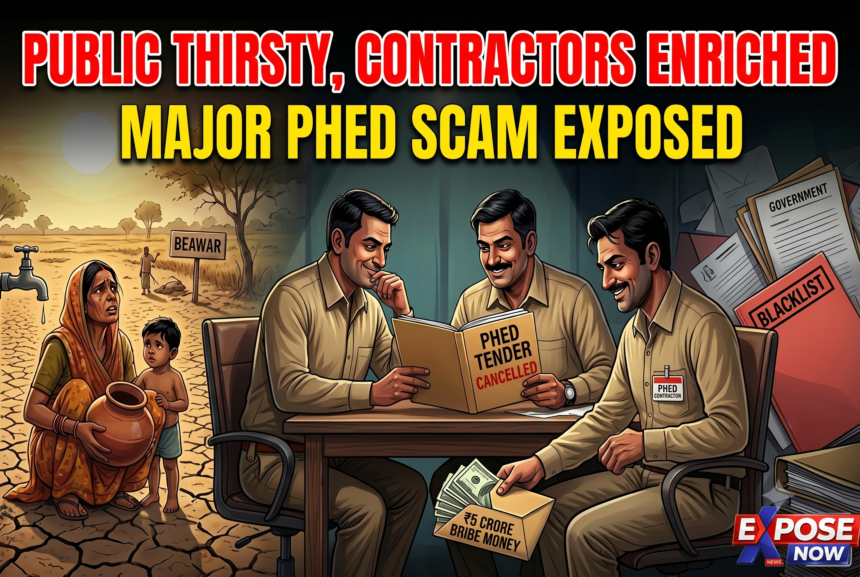
Special Investigative Report
Jaipur/Beawar: A fresh case of alleged collusion between officials of the Public Health Engineering Department (PHED) and private contractors has surfaced in Rajasthan, raising serious questions over transparency in government tenders and the implementation of public welfare projects. The controversy revolves around the ₹43.03 crore “Bhomada Dam Drinking Water Supply Scheme,” approved under the Chief Minister’s Budget Announcement 2025-26 for 12 villages in Raipur subdivision of Beawar district.
According to documents and departmental sources, PHED engineers and a private construction company allegedly worked together to manipulate the tender process through a calculated “bid validity” strategy, ultimately leading to the cancellation of the entire tender. The alleged conspiracy not only protected the contractor from financial penalties and blacklisting but also caused significant delays in a crucial drinking water project meant for water-scarce villages.
Company Trapped by Low Bid, Then Began the ‘Mind Game’
After technical bids were opened, M/s Balaji Construction Company emerged as the L-1 bidder by quoting 10.78 percent below the NIT cost. The company submitted a bid of ₹38,39,64,673.60, significantly lower than the estimated project value.
However, sources claim that once the financial calculations were assessed internally, the contractor realized that executing the project at such a low rate would substantially reduce profit margins and potentially result in losses. Under Rajasthan Transparency in Public Procurement (RTPP) Rules, refusal to execute the work after becoming the successful bidder could have led to forfeiture of the Earnest Money Deposit (EMD), debarment, or even blacklisting of the company.
To avoid these consequences, the contractor allegedly entered into an understanding with PHED officials and senior engineers, after which the tender process was deliberately slowed down.
More Read

File Delays and Bid Validity Extension Became the Core Strategy
According to the investigation, the tender file was intentionally delayed at multiple administrative levels while the validity period of the bid was extended. Balaji Construction initially agreed to extend its bid validity till February 15, 2026.
However, once the extended validity period expired, the company reportedly refused to extend it any further. PHED officials then invoked provisions of Rule 48(2) of the RTPP Rules, 2013, treating the situation as a “bid withdrawal.”
Following this, the department approached the L-2 bidder, M/s Bihani Construction, with a counter-offer. But on March 23, 2026, Bihani Construction also declined to extend the bid validity period. As a result, the validity of all bids expired, forcing the department to annul the tender completely.
More Read

Contractor Allegedly Escaped Losses Worth Crores
Experts familiar with government procurement processes believe the cancellation effectively allowed the contractor to escape a financially unfavorable project without facing any punitive action.
Had Balaji Construction directly refused to execute the project, PHED could have forfeited its EMD and initiated blacklisting proceedings. Instead, the company allegedly exited the project safely through procedural manipulation, while also protecting its market credibility and eligibility for future tenders.
Industry observers estimate that by avoiding losses and escaping penalties, the company may have gained a strategic and financial advantage of nearly ₹5 crore.
Villagers Left Without Drinking Water
While the alleged nexus benefited the contractor, the biggest sufferers are the residents of 12 villages in Raipur subdivision, who were expecting relief under the Chief Minister’s budget announcement.
The Bhomada Dam Drinking Water Supply Scheme was designed to provide drinking water to drought-prone rural areas facing severe summer shortages. With the tender now cancelled, the project has been pushed back indefinitely, leaving villagers once again dependent on uncertain water arrangements during peak summer months.
Government to Bear Additional Financial Burden
The cancellation has also resulted in major administrative and financial setbacks for the state government. PHED will now have to initiate the tender process again through fresh bidding, which could take several more months.
More Read

Officials acknowledge that re-tendering is likely to increase project costs due to revised market rates, inflation, and administrative expenses. Apart from delaying the scheme, the process will consume additional government resources and public money.
Tender Cancelled Under New Finance Committee Leadership
Sources indicate that the newly appointed chairman of the finance committee, Hemant Gera, was reportedly unaware of the alleged internal coordination between officials and the contractor. With no legally valid bids remaining, the committee had little option but to cancel the tender and invite fresh bids.
Despite the project remaining unresolved even 15 months after the original budget announcement, no PHED engineer or official has reportedly been held accountable for the delay.
Serious Questions Over Administrative Delay
The controversy has now sparked larger questions regarding accountability within PHED. Documents suggest that the Bid Evaluation Committee had already recommended Balaji Construction on February 13, 2026. Critics are now questioning why the file remained pending for so long that the contractor eventually secured a safe exit route.
Opposition voices and public policy observers are demanding an independent inquiry into whether the delay was deliberate and whether officials responsible for handling the tender process facilitated the cancellation to protect the contractor.
The case has once again highlighted alleged systemic issues in Rajasthan’s public procurement system, where delayed decision-making, procedural loopholes, and bureaucratic discretion may be undermining major public infrastructure projects.