

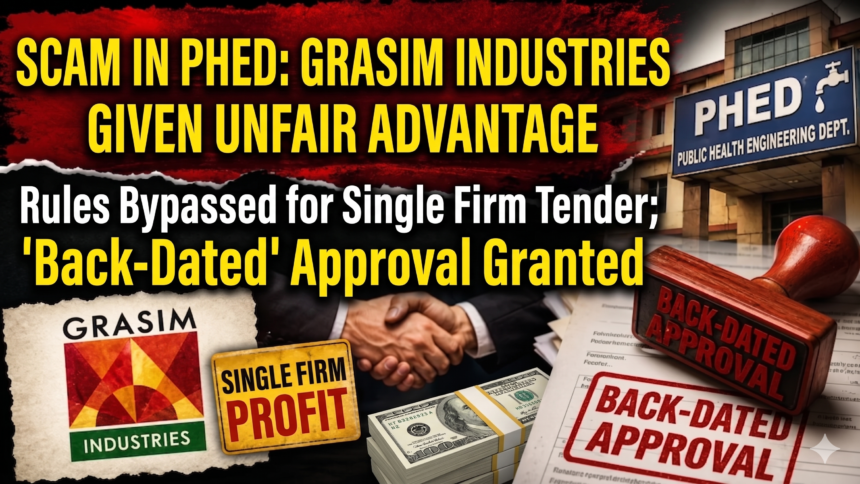
Jaipur: Rajasthan’s Public Health Engineering Department Rajasthan has come under fresh scrutiny after serious allegations surfaced regarding procedural violations and alleged favoritism in the procurement of water treatment chemicals through a controversial single-bid tender.
The controversy relates to the purchase of Poly Aluminium Chloride (PAC), a chemical widely used in water purification, under NIB No. PAC/25-26/14 dated February 16, 2026. According to documents reviewed by “Expose Now,” officials allegedly bypassed mandatory procurement procedures and later secured retrospective approvals to regularize the process in favour of the sole bidder, Grasim Industries Limited, Nagda.
Technical and Price Bids Opened Without Finance Committee Approval
At the centre of the controversy is the allegation that PHED officials opened both the technical and financial bids without obtaining prior approval from the Finance Committee (FC), despite procurement norms requiring mandatory committee clearance in cases involving a single bidder.
During the Finance Committee meeting, the Chief Engineer (Administration) reportedly admitted that a major procedural lapse had occurred during the tender process.
As per procurement procedures, whenever only one bidder participates in a tender, the technical bid must first be placed before the Finance Committee for approval before any further evaluation or opening of price bids.
More Read

However, documents suggest that officials allegedly bypassed this requirement and allowed the Bid Evaluation Committee (BEC) to directly declare the bidder technically qualified. The financial bid was then reportedly opened on March 18, 2026, without Finance Committee authorization.
Critics argue that the sequence of events indicates either gross administrative negligence or deliberate manipulation aimed at favouring the selected company.
Tender Rates Significantly Higher Than Assessed Rates
The controversy intensified after it emerged that the rates quoted by Grasim Industries were substantially higher than departmental assessed rates and previously approved prices.
More Read

According to procurement records:
- For Medium Basicity Poly Aluminium Chloride, the company quoted ₹11,286 per metric tonne (excluding GST), which was reportedly 12.18 percent higher than the assessed rate and 8 percent higher than previous approved rates.
- For High Basicity Poly Aluminium Chloride, the quoted price was ₹11,729 per metric tonne (excluding GST), allegedly 12.54 percent above assessed rates and 7.99 percent higher than earlier approved rates.
Despite the higher pricing, officials reportedly did not recommend cancellation of the tender. Instead, the Chief Engineer was instructed to initiate negotiations with the company and, if necessary, issue a “counter-offer” to finalize the procurement.
Procurement experts argue that accepting a single tender at rates substantially above benchmark estimates could place unnecessary financial burden on the state exchequer.
Retrospective Approval Raises Questions
The Finance Committee reportedly expressed formal concern over the procedural lapse but subsequently condoned the violations by granting “ex-post facto” approval — retrospective sanction issued after actions had already been taken.
The approval has triggered criticism from transparency advocates, who argue that retrospective clearances weaken accountability mechanisms and effectively legitimize procedural violations after the fact.
Old Rate Contracts Extended Up to ₹15 Crore
Officials reportedly defended the decision by citing urgent summer demand for water treatment chemicals and the need to ensure uninterrupted drinking water supply operations across Rajasthan.
More Read

Using “public urgency” as justification, the department allegedly approved continuation of supply orders under the existing rate contract up to a financial ceiling of ₹15 crore until the new tender process is finalized.
Critics, however, argue that the situation arose due to departmental delays and poor planning, and that emergency justifications are now being used to shield officials from scrutiny.
Questions Over Procurement Governance
The latest controversy has intensified concerns regarding procurement transparency and internal oversight mechanisms within PHED, particularly amid a series of recent allegations involving tender management and administrative approvals.
The case has raised several critical questions:
- Why were mandatory Finance Committee approvals bypassed in a sensitive procurement matter?
- Why was a single-bid tender with rates significantly above assessed benchmarks allowed to proceed?
- Was the procedural lapse merely administrative negligence or part of a larger pattern of favoritism toward select companies?
- Should retrospective approvals be permitted in high-value public procurement cases?
The PAC procurement controversy is expected to add further pressure on the department as demands grow for a detailed independent inquiry into tender management practices and financial accountability within PHED.