

Jaipur: The implementation of drinking water projects under the Jal Jeevan Mission (JJM) in Rajasthan is likely to face further delays after the Finance Committee (FC) of the Public Health Engineering Department (PHED) deferred a proposal seeking amendments in eligibility and pre-qualification (PQ) criteria for Hybrid Annuity Model (HAM)-based tenders.
The proposal, brought forward by the department to encourage wider participation of firms in upcoming tenders, was put on hold after the committee raised serious objections over the removal of a key financial eligibility clause linked to bidders’ financial strength.
The decision is expected to slow down the tendering process for several upcoming HAM-based water supply projects under the centrally sponsored Jal Jeevan Mission.
Proposal Aimed at Increasing Bidder Participation
According to departmental sources, the proposal was presented before the Finance Committee by the Chief Engineer (Special Projects), PHED.
More Read

Officials argued that certain relaxations and modifications in tender conditions were necessary to attract more bidders and improve competition in HAM-based infrastructure projects.
The proposed amendments included changes in:
- Net worth requirements
- Technical qualification criteria
- Work experience eligibility
- Blacklisting conditions
The department maintained that easing some provisions would enable more infrastructure firms and joint ventures to participate in large-scale rural drinking water projects across Rajasthan.
More Read

Proposed Changes in Eligibility Criteria
Net Worth Conditions
Under the revised proposal:
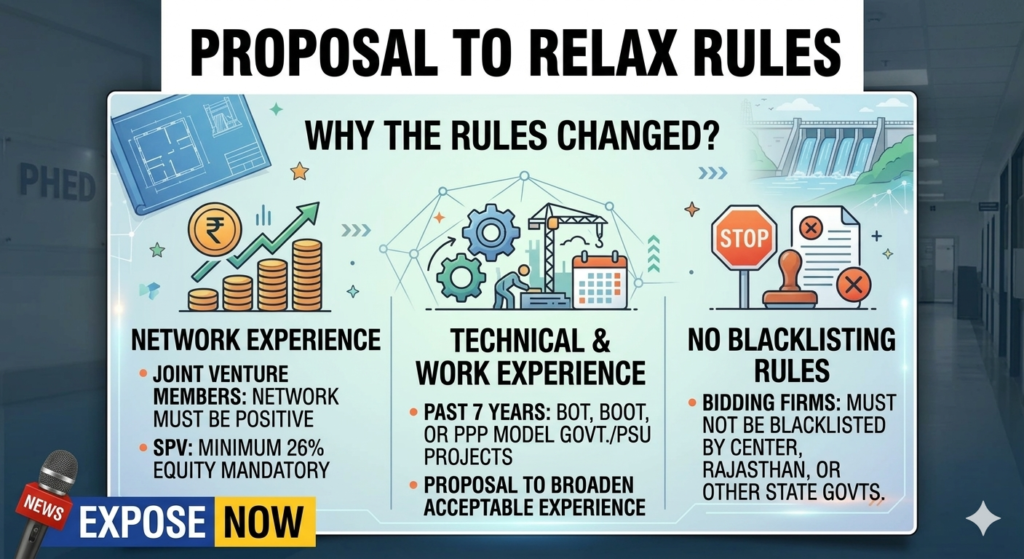
- The bidding company’s minimum net worth in the previous financial year was required to be at least 20 percent of the estimated project cost.
- In case of a Joint Venture (JV), each member was required to maintain a positive net worth.
- A minimum 26 percent equity participation in the Special Purpose Vehicle (SPV) was proposed as mandatory.
Technical and Work Experience
The department also proposed expanding the scope of eligible experience by including projects executed for government departments and Public Sector Undertakings (PSUs) under:
- BOT (Build-Operate-Transfer)
- BOOT (Build-Own-Operate-Transfer)
- PPP (Public-Private Partnership) models
Minor changes in the definition and evaluation of work experience were also proposed to make participation easier for infrastructure firms.
Blacklisting Restrictions
The revised conditions stated that any bidding entity should not be banned or blacklisted by:
- The Government of India
- Rajasthan Government
- Any other state government
Finance Committee Raises Red Flag Over Removal of Key Financial Clause
During detailed discussions, the Finance Committee reportedly noticed that the revised proposal had removed a critical clause related to “Financial Resources.”
Under the earlier provisions, concessionaires or executing firms were required to demonstrate total financial resources equivalent to at least 60 percent of the estimated project cost to ensure their capability to execute and sustain HAM-based projects.
More Read

Committee members expressed concern that removing this clause could weaken the financial scrutiny of bidders and increase the risk of projects stalling midway due to lack of funds.
Sources said the committee strongly believed that for large and technically complex HAM projects, assessing the financial capacity of contractors is essential to safeguard public investment and ensure timely completion.
Proposal Deferred for Reconsideration
Considering the seriousness of the issue, the Finance Committee decided to defer the agenda and directed the Chief Engineer (SP), PHED, to re-examine the deleted financial resource clause.
The department has now been instructed to submit a revised proposal incorporating necessary corrections and stronger financial safeguards in future meetings.
Delay Likely in Upcoming JJM HAM Tenders
The latest decision means that tender processes for several upcoming Jal Jeevan Mission projects based on the Hybrid Annuity Model may now face additional delays.
The HAM model is considered crucial for accelerating large-scale rural drinking water infrastructure development in Rajasthan, particularly in water-stressed regions. However, the ongoing debate over bidder eligibility and financial safeguards has once again exposed administrative challenges within the department.
Officials say fresh discussions on revised criteria are likely in the coming weeks before the projects can move forward toward tender issuance and implementation.