

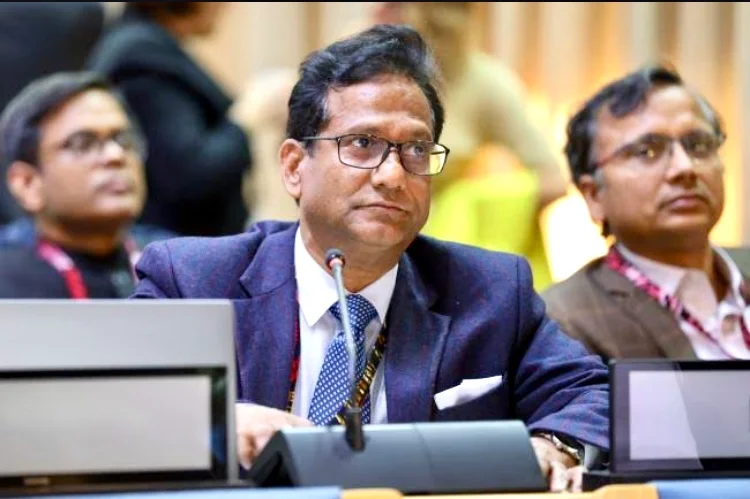
New Delhi/Jaipur: A controversy has erupted over the allocation of government horticulture subsidies after reports revealed that Union Minister of State for Agriculture Bhagirath Choudhary and family members of senior IAS officer Naresh Pal Gangwar received substantial financial assistance under a Central Government scheme designed to promote commercial horticulture.
The disclosures have sparked a debate over transparency, conflict of interest, and ethical standards in the administration of public subsidy programmes. While no investigating agency has alleged criminal wrongdoing, the revelations have prompted questions from political observers and governance experts regarding whether public officials and their immediate family members should receive benefits from schemes administered by departments connected to their official positions.
Minister Received Nearly ₹1 Crore Subsidy
According to official records cited in media reports, Union Minister of State for Agriculture Bhagirath Choudhary received a subsidy of approximately ₹99.6 lakh for a commercial cucumber cultivation project in Rajasthan.
The assistance was sanctioned under the National Horticulture Board (NHB)‘s “Development of Commercial Horticulture” scheme, which operates under the Ministry of Agriculture and Farmers’ Welfare. The project reportedly involved an investment of about ₹1.99 crore, with the subsidy covering nearly half of the eligible project cost, in accordance with the scheme’s provisions.
The issue has attracted attention because the National Horticulture Board functions under the same ministry in which Choudhary serves as Minister of State and is an ex-officio Vice-Chairman of the NHB Board.
More Read

However, reports indicate that subsidy approvals under the scheme are processed by a designated Project Approval Committee rather than by the minister or the NHB Board itself.
Minister Denies Any Wrongdoing
Responding to the controversy, Bhagirath Choudhary rejected allegations of impropriety.
The minister stated that he had applied for assistance several years before assuming ministerial office and that the project complied with all applicable rules. He also said the project details, including government assistance and bank financing, are displayed at the farm as required under the scheme.
More Read

Choudhary emphasized that he is a farmer by profession and argued that the subsidy programme is available to all eligible farmers who satisfy the prescribed conditions. He maintained that there had been complete transparency throughout the process and denied using his official position to obtain any benefit.
IAS Officer’s Family Also Received Subsidies
The controversy widened after reports indicated that the mother, wife, and son of senior IAS officer Naresh Pal Gangwar, currently serving as Secretary in the Department of Animal Husbandry and Dairying, collectively received more than ₹1.16 crore under the same National Horticulture Board scheme over multiple years.
According to the reports, the subsidy was distributed across separate projects undertaken by different family members.
Questions were also raised regarding disclosures made in mandatory property returns. Reports noted that one approved project was reflected in the officer’s declaration, while other projects involving family members were not included. Gangwar has maintained that his disclosures were made in accordance with the applicable service rules governing asset declarations.
Debate Over Conflict of Interest
The controversy has fueled a broader discussion about conflict-of-interest standards in public administration.
Governance experts note that a conflict of interest does not necessarily imply illegality. Instead, it refers to situations in which an official’s public responsibilities and private interests may appear to overlap, potentially affecting public confidence.
More Read

Legal experts point out that determining whether any rules were violated would depend on whether the subsidy applications complied with the scheme guidelines, whether the beneficiaries met all eligibility conditions, and whether decision-makers involved in approving the projects acted independently.
How the Subsidy Scheme Works
The National Horticulture Board administers the commercial horticulture scheme under the Mission for Integrated Development of Horticulture (MIDH), which aims to encourage protected cultivation, polyhouses, and high-value horticultural crops.
Eligible farmers may receive financial assistance for projects involving crops such as cucumbers, tomatoes, capsicum, flowers, and other horticultural produce. Subsidies are generally linked to project cost, subject to prescribed ceilings and technical verification.
Applications undergo multiple stages, including online submission, technical scrutiny, field inspections, and approval by designated committees before financial assistance is released.
Political Reactions
The disclosures have triggered political reactions, with opposition leaders demanding greater transparency in the implementation of subsidy schemes.
Critics argue that even if the beneficiaries fulfilled the eligibility criteria, public confidence requires higher ethical standards when ministers or families of senior government officials benefit from schemes connected to government departments.
Supporters of the beneficiaries, however, contend that public office should not automatically disqualify otherwise eligible individuals from government programmes, provided the selection process is transparent, independent, and fully compliant with the law.
No Findings of Illegality
As of publication, no investigative agency, court, or vigilance authority has concluded that any laws were violated in the sanctioning of the subsidies.
The available information indicates that the projects were processed under the existing framework of the National Horticulture Board scheme. Whether the matter leads to further administrative review or policy changes regarding conflict-of-interest safeguards remains to be seen.
The episode has nevertheless reignited discussion on the need for stronger transparency measures, enhanced disclosure requirements, and clearer ethical guidelines governing the participation of public office holders and their families in government welfare and subsidy programmes.