

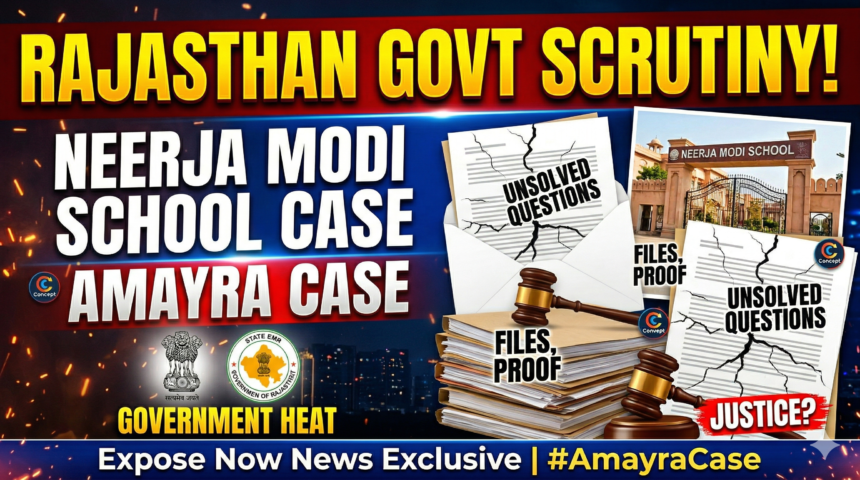
Jaipur, Rajasthan – The tragic death of a young student at Neerja Modi School has sparked intense public scrutiny and renewed pressure on the Rajasthan Government’s Education Department over allegations of negligence, poor student safety, and delayed administrative action.
On 1 November 2025, nine‑year‑old Amayra Kumar, a Class 4 student, fell from the fourth floor of the school building and died in a tragic incident that authorities are treating as a suicide. The case triggered widespread outrage across Jaipur and beyond, especially after allegations emerged that the death was linked to prolonged bullying and inadequate supervision at the school.
📌 Family and Public Concerns
Amayra’s family, supported by parents’ groups and community members, has repeatedly accused the school administration of failing to act on repeated complaints about bullying and harassment. According to reports, Amayra had expressed reluctance to attend school in the days before her death, and classmates told investigators she had been under emotional distress.
In the days after the incident, questions were raised about whether warnings and complaints from parents were taken seriously by teachers and school officials — and why the school environment lacked effective anti‑bullying measures and physical safeguards to prevent students from accessing high‑risk areas without supervision.
🧑⚖️ Department and Board Actions
Following a detailed inquiry by the Central Board of Secondary Education (CBSE), the board cancelled the school’s senior secondary affiliation, citing serious safety lapses and violations of child safety norms. The CBSE said these violations exposed students to risk and indicated systemic administrative failures.
More Read

In response, the Rajasthan Education Department also issued its own order restricting fresh admissions for upper classes and reviewing the school’s compliance with state education regulations. Officials said the department’s action was grounded in safety concerns and aimed at protecting students’ welfare while the broader inquiry continued.
🧠 Why the Government Is Under Pressure
Despite these sanctions, Amayra’s family and several parents’ groups remain unsatisfied with the state government’s response. They argue that the Education Department should have taken proactive action earlier and question why it took external pressure and a CBSE intervention before stringent measures were enforced. They insist that if a school is unsafe for higher grades, it must be held accountable across all levels — not only where affiliation bylaws permit.
Critics also contend the department needs clearer protocols for handling bullying complaints, mental health issues, and safety compliance so that similar tragedies are prevented in the future rather than addressed only after public outcry.
More Read

📣 Debate on Safety and Accountability
The case has fueled a broader debate on school safety standards in Rajasthan, including how quickly authorities respond to potential risks and how effectively government bodies — both the state education department and national boards — enforce regulations. Parents are urging stronger oversight and independent reviews to ensure schools comply with best practices for student protection.
As police, educational authorities, and child rights activists await further investigation reports, the public demand for accountability and reform continues to grow — highlighting systemic challenges in student safety and institutional responsibility within private educational institutions.