

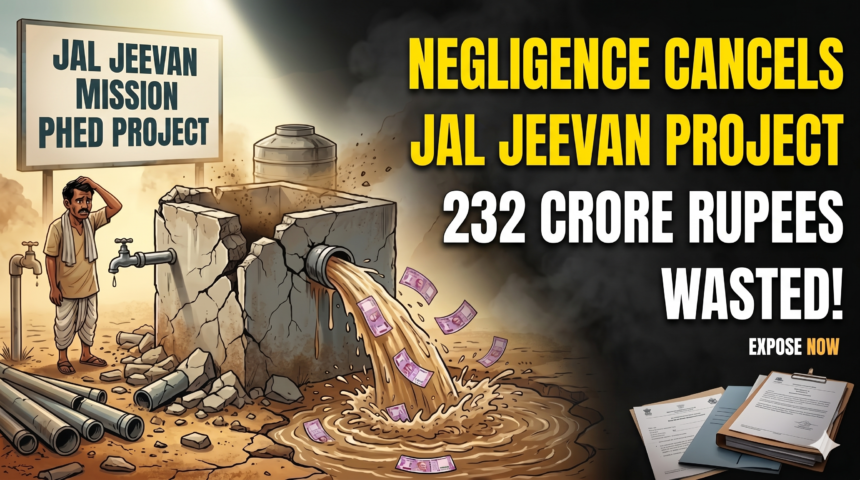
Jaipur: Serious questions have emerged over the functioning of Rajasthan’s Public Health Engineering Department (PHED) after a major Jal Jeevan Mission (JJM) project worth ₹232.30 crore in Bharatpur district was officially cancelled following prolonged administrative delays and the expiry of bid validity periods.
The cancelled project, linked to the “Chambal Dholpur Bharatpur Project (Package-3),” was aimed at providing Functional Household Tap Connections (FHTCs) to rural households in several villages of Bharatpur region. However, despite the tender process beginning in January 2025 and the financial committee approving the lowest bidder months ago, the project failed to reach the work-order stage even after nearly 17 months.
The development has intensified criticism of PHED’s tender management system and administrative efficiency, especially since the project pertains to the Chief Minister’s home district region.
Project Stuck in Files, Finally Cancelled
According to official records, the Notice Inviting Tender (NIT No. 01/2024-25) for the project was issued in January 2025. Four bidders participated in the process.
The timeline of the tender process reveals prolonged delays:
More Read

- February 11, 2025: Technical bids were opened.
- June 25, 2025: Three bidders were technically qualified.
- June 30, 2025: Financial bids were opened.
- July 2025: M/s Shree Hari Infra Projects Pvt. Ltd. emerged as the lowest bidder (L1) with a quoted amount of ₹259.06 crore.
The Financial Committee (FC904) reportedly approved the proposal. However, since the quoted amount was approximately 11.52 percent higher than the original estimated project cost of ₹232.30 crore, the file had to be sent to the Finance Department on July 24, 2025, for approval of the tender premium and issuance of work order clearance.
Administrative Delay Leads to Expiry of Bid Validity
The case took a dramatic turn after the file remained pending for months without final approval.
During this period, the validity of bids submitted by participating companies gradually expired:
More Read

- M/s LNA Infra and M/s Universal MEP saw their bid validity expire on July 11, 2025.
- M/s Keystone Infra’s validity expired on August 31, 2025.
- The L1 bidder, M/s Shree Hari Infra Projects Pvt. Ltd., had extended validity until March 14, 2026.
Officials had nearly eight months to complete the approval process, but no final decision was taken within that period. Eventually, even the L1 bidder reportedly refused to extend the bid validity any further.
As all bid validity periods expired, the department was left with no option but to annul the entire tender process under Rule 72 of the RTPP Rules, 2013. The project will now require fresh bidding, restarting the entire tender cycle from the beginning.
Villages Continue Waiting for Water Supply
The cancellation is expected to significantly delay water supply connectivity for rural households in Bharatpur, Roopbas, Uchain and Kumher blocks, where residents were expected to benefit from household tap connections under the Jal Jeevan Mission.
Experts believe that re-tendering the project could further escalate costs due to inflation, revised market rates, and fresh administrative procedures, causing additional financial burden on the exchequer and delaying infrastructure delivery on the ground.
Questions Raised Over Accountability
The incident has sparked sharp criticism within administrative circles and among observers monitoring JJM implementation in Rajasthan.
Several key questions are now being raised:
More Read

- Why was the Finance Department approval not secured during the eight-month window when the L1 bid remained valid?
- Who is accountable for the delay that caused the collapse of the entire tender process?
- Why has no responsibility reportedly been fixed despite the cancellation of such a major public project?
- Could the prolonged delay indicate deeper procedural manipulation or favouritism within the tender process?
The controversy has also intensified after reports that the Financial Committee expressed “strong displeasure” over the fact that a tender approved in July 2025 ultimately had to be cancelled due to administrative inaction.
Higher Authorities Seek Explanation
Following the collapse of the project, senior authorities have reportedly directed the Chief Engineer (Special Projects), PHED Jaipur, to ensure timely follow-up in future cases and submit a detailed explanation regarding the delays.
A report has also been sought covering the complete timeline from administrative and financial approval by the State Level Scheme Sanctioning Committee (SLSSC) to the eventual cancellation of the tender.
However, critics point out a potential conflict in the inquiry process itself, arguing that the same PHED hierarchy allegedly responsible for the delay is now being asked to explain the reasons behind it.
Bigger Concerns Over JJM Execution
The episode has once again highlighted larger concerns surrounding the implementation of Jal Jeevan Mission projects in Rajasthan, including delays in approvals, rising project costs, tender premium disputes, and weak accountability mechanisms.
Observers believe the case could become a major test of administrative transparency within PHED, especially at a time when the Centre has already tightened scrutiny over JJM expenditures and tender-related practices in the state.
Whether the department fixes accountability or allows the issue to fade into procedural routine remains to be seen.