
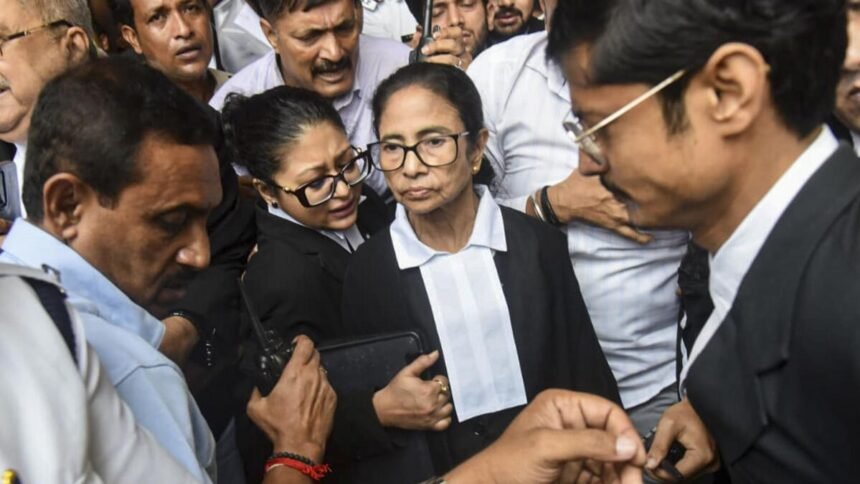
Kolkata: West Bengal Chief Minister Mamata Banerjee’s recent visit to the Calcutta High Court turned politically charged after slogans of “Jai Shri Ram” were raised in and around the court premises, reigniting the long-standing political and ideological battle between the ruling Trinamool Congress (TMC) and the Bharatiya Janata Party (BJP) over the slogan’s use in West Bengal politics.
Videos and visuals from the event quickly spread across social media platforms, showing groups of individuals raising religious and political slogans as the Chief Minister arrived. The incident has once again brought attention to the politically sensitive history associated with the slogan in Bengal’s political landscape over the past several years.
“Jai Shri Ram” Slogan Has Been at the Center of Bengal Politics
The slogan “Jai Shri Ram,” traditionally considered a religious chant by many Hindus, gradually evolved into a major political flashpoint in West Bengal during the intense political rivalry between the TMC and BJP, especially ahead of the 2019 Lok Sabha elections and the 2021 West Bengal Assembly elections.
During several past public events, Mamata Banerjee had publicly objected to the slogan being raised in political contexts directed at her convoy or public appearances. On multiple occasions, videos surfaced showing the Chief Minister stopping her vehicle and confronting individuals who shouted the slogan near her public rallies or roadshows.
The BJP and opposition leaders had accused the state government at the time of attempting to suppress religious expression and targeting political opponents. The TMC, however, consistently maintained that objections were not against religious sentiments but against what it termed “provocative political sloganeering” intended to create confrontation and disturb public order.
More Read

Allegations and Counter-Allegations Over Detentions
Over the years, several incidents involving detention or police action against individuals accused of creating disturbances during political events became subjects of intense debate in the state.
Opposition parties alleged that supporters and ordinary citizens were targeted for chanting “Jai Shri Ram,” while the ruling party denied any blanket restriction on religious slogans. TMC leaders argued that police interventions were linked to law-and-order concerns rather than religious expression.
Political analysts believe the controversy significantly contributed to the BJP’s rise in West Bengal by helping consolidate sections of Hindu voters who viewed the slogan as a symbol of cultural assertion and political resistance.
More Read

Slogans at High Court Visit Fuel Political Messaging
The latest incident at the Calcutta High Court has once again sparked sharp reactions across political circles and social media platforms.
Supporters of the BJP described the slogan shouting as symbolic of changing political sentiments in Bengal, while TMC leaders accused opponents of attempting to politicize judicial spaces and provoke controversy.
Neither the Chief Minister’s Office nor senior court officials issued any major public statement regarding the slogan-shouting incident immediately after the event. However, the visuals have intensified online political commentary and revived discussions around freedom of expression, political symbolism, and the use of religious slogans in public discourse.
Bengal’s Political Climate Remains Highly Polarized
West Bengal continues to witness sharp ideological polarization between the TMC and BJP, with religion, identity politics, and political symbolism remaining central themes in electoral and public debates.
Observers note that slogans such as “Jai Shri Ram” have moved beyond purely religious usage in the state and now often carry strong political undertones depending on the context in which they are used.
The latest episode is likely to further deepen political confrontation ahead of future electoral battles in the state, where symbolic gestures and public messaging continue to play a major role in shaping voter sentiment.