

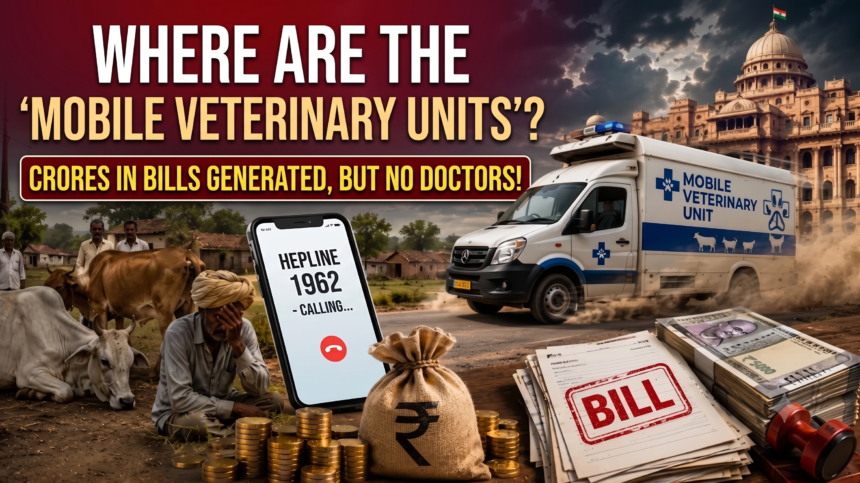
Jaipur : A massive irregularity has allegedly surfaced in Rajasthan’s animal husbandry sector, where crores of rupees are reportedly being spent every month in the name of Mobile Veterinary Units (MVUs), while the actual emergency veterinary service system remains largely ineffective on the ground.
Under the state-wide scheme, 536 Mobile Veterinary Units are officially operating across Rajasthan to provide emergency medical treatment to livestock through the “1962 Veterinary Helpline.” However, serious allegations of corruption, fake billing, staff shortages, lack of monitoring, and poor emergency response have now raised questions over the functioning of the entire system.
According to sources, the government is paying nearly Rs 9.48 crore every month to contracted firms operating these mobile units. Shockingly, approximately Rs 1.77 lakh per month is being paid for each individual van, despite allegations that many units either function without qualified doctors or fail to provide timely services to livestock owners.
No Proof of Treatment, No Geo-Tagging, No Monitoring
One of the most alarming aspects of the scheme is the alleged absence of any credible monitoring mechanism.
As per the allegations:
More Read

- No photographs of treated animals are being recorded.
- No video documentation of field treatment is maintained.
- Vehicles are not geo-tagged during service visits.
- No digital verification exists to prove whether vans actually reached the location of complaint or not.
Due to these loopholes, questions are now being raised over whether emergency treatment is genuinely being provided or whether bills are allegedly being generated only on paper.
Experts say the absence of geo-tracking and digital proof creates a system vulnerable to fake attendance, fabricated treatment records, and inflated billing.
Ground Investigation Reveals Serious Gaps
During field verification conducted in multiple villages, livestock owners reportedly faced repeated difficulties while trying to access the emergency veterinary service through the 1962 helpline.
More Read

According to villagers:
- Calls to the helpline often go unanswered.
- In some cases, callers are told that the mobile unit will arrive “within one or two hours,” after which the call is disconnected.
- Even after repeated follow-up calls, veterinary vans either arrive very late or do not arrive at all.
In several reported instances, when the mobile unit finally reached the location, neither a qualified veterinary doctor nor proper medicines were available.
Instead, veterinary students allegedly handled emergency cases and distributed medicines with questionable packaging standards. Some medicines reportedly had missing expiry dates, while others were already opened before use.
These revelations have triggered serious concerns regarding both animal safety and misuse of government funds.
Question Raised in Assembly, No Reply for Six Months
The issue has also reached the Rajasthan Legislative Assembly.
Makrana MLA Zakir Hussain Gasawat had reportedly raised a starred question seeking detailed information about the functioning, staffing, expenditure, and monitoring of the Mobile Veterinary Unit scheme.
More Read
However, according to sources, even after six months, the department has allegedly failed to provide a complete response.
The prolonged silence from the department has intensified suspicions regarding possible irregularities in the implementation of the scheme.
Official Claims vs Ground Reality
While field reports indicate serious operational failures, official records reportedly continue to show smooth functioning of the system.
For example, in Nagaur district alone:
- A total of 13 Mobile Veterinary Units are officially operational.
- Each unit receives around Rs 1.77 lakh per month under the contract.
- The payment includes expenses for doctors, vehicles, medicines, and emergency operations.
Officials claim that all 13 veterinary doctors are posted under the Joint Director’s office. However, sources allege that many doctors remain absent from headquarters for long durations in the name of field duty, leading to a shortage of qualified doctors for actual emergency van deployment.
This has raised concerns that attendance manipulation and weak supervision may be enabling large-scale financial irregularities within the system.
Questions Over Accountability
The controversy has now sparked broader questions over transparency and accountability in Rajasthan’s veterinary healthcare system.
Critics argue that a scheme launched to protect livestock and support rural cattle owners is allegedly being reduced to a paperwork exercise where:
- Emergency services are unreliable,
- Monitoring systems are weak,
- Contractors continue receiving large payments, and
- Accountability mechanisms remain absent.
If the allegations are proven true, the matter could expose one of the largest operational failures in the state’s veterinary emergency response network.
The focus will now remain on whether the government initiates an independent audit into the scheme, fixes responsibility on district-level officials and contractors, and introduces stricter digital monitoring systems to prevent misuse of public money.