

Jaipur/Jhalawar: In a glaring example of administrative negligence within the Public Health Engineering Department (PHED), a crucial drinking water project worth ₹31.53 crore meant to supply water to Bhawani Mandi, Sunel town, Piplad and 14 surrounding villages in Rajasthan’s Jhalawar district has been scrapped after officials committed a serious procedural lapse during the tendering process.
The project, announced under the Rajasthan Government’s Budget 2024-25, has now been annulled by the department’s Finance Committee (FC), triggering major delays in water supply improvements for thousands of residents already facing drinking water shortages.
The cancellation has raised serious questions over accountability, transparency and adherence to procurement rules within PHED, as no officer has yet been held responsible for the costly mistake.
Tender Process Collapsed Due to ‘Inexcusable’ Procedural Error
According to departmental records, the entire bidding process was invalidated because PHED officials failed to legally publish Corrigendum No. 1 and Corrigendum No. 2 in newspapers as required under the Rajasthan Transparency in Public Procurement (RTPP) Rules, 2013.
The violation specifically relates to Rule 43, Rule 43(7), and Rule 51(2) of the RTPP framework, which mandate proper public disclosure of changes made during tender proceedings.
More Read

The Bid Evaluation Committee (BEC), during scrutiny of the tender process, reportedly found that the corrigendums had not been published through the legally prescribed mechanism. As a result, the committee concluded that the transparency and fairness of the entire bidding process had been compromised, leaving no scope for rectification.
Officials internally described the situation as a “fait accompli” — a legal term used when a mistake or event reaches a stage where corrective action is no longer possible and the only option left is cancellation.
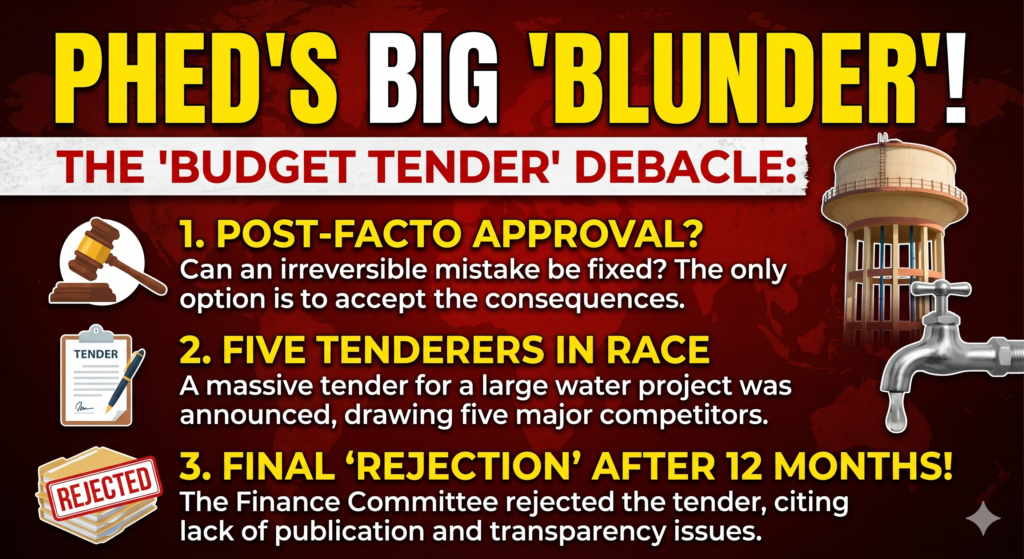
Five Firms in Race, Months Lost in Delays
Five construction firms had participated in the bidding process for the project:
More Read

- M/s Godara Construction Company
- M/s Balaji Construction Company
- M/s Gulab Chand Kumawat
- M/s RRBC Infra Project Pvt. Ltd.
- M/s Kailash Chand Chaudhary
The technical bids were submitted on August 29, 2025. However, due to prolonged delays in scrutiny and evaluation, bidders were repeatedly asked to extend the validity of their offers — some until December 2025 and others until March 2026.
Despite months of procedural movement, the tender ultimately collapsed because of the department’s own legal and administrative lapses.
File Moved Through Multiple Committees Before Final Rejection
The irregularities surfaced during the fourth meeting of the Empowered Procurement Committee (EPC) held on November 10, 2025, where concerns were raised regarding the eligibility of one participating firm, M/s Kailash Chand Chaudhary.
Following this, a re-examination of the tender was ordered.
The matter was later reviewed in a meeting chaired by the Chief Engineer (Urban & NRW) on December 23, 2025. During the review, officials reportedly discovered that the corrigendums had never been published in compliance with RTPP provisions.
Subsequently, during the sixth EPC meeting held on January 5, 2026, a recommendation was made to annul the entire tender process. The Finance Committee has now approved that recommendation, officially cancelling the project tender.
More Read

Fresh Tender Ordered, Public Faces More Delay
After annulling the bidding process, the Finance Committee directed the Chief Engineer (CE, U&NRW) to immediately initiate a fresh tender process.
However, the decision means the project will now face several more months of delay, as the department must restart the process from scratch — including issuance of a new tender, bid submissions, evaluations and work order approvals.
The project also included a 10-year operation and maintenance (O&M) component, making it a significant long-term infrastructure initiative under the state government’s drinking water expansion plans.
Residents of Bhawani Mandi, Sunel and nearby villages, who were expecting relief from chronic water shortages, are now likely to wait much longer due to what critics describe as avoidable bureaucratic incompetence.
The incident has also intensified demands for strict action against responsible engineers and officials who allegedly ignored procurement rules and jeopardized a public welfare project involving crores of rupees.