

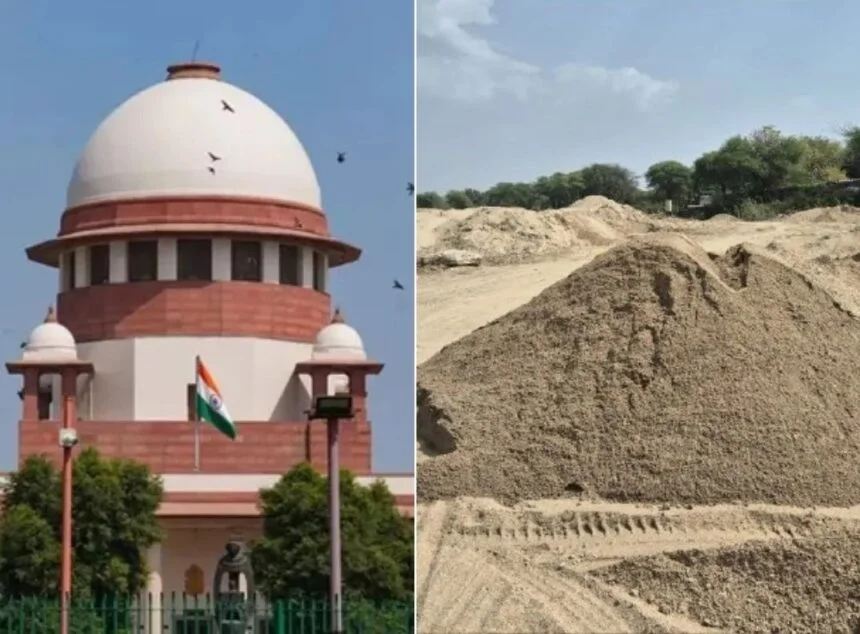
Jaipur/New Delhi: Rajasthan’s mining sector has been pushed into a fresh phase of uncertainty after the Supreme Court agreed to examine the legality of the Rajasthan High Court’s order cancelling dozens of gravel and sand mining leases across the state. While the apex court has issued notices on the matter, it has also continued restrictions on mining activities, effectively putting several mining operations on hold until the next hearing scheduled for July 20.
The development has triggered concerns among mining lease holders, infrastructure developers, contractors, and industries dependent on the supply of gravel, sand, and other construction materials. The ongoing legal battle is expected to have significant implications for Rajasthan’s mining economy, government revenues, and infrastructure projects.
Supreme Court to Review High Court Verdict
The controversy stems from the Rajasthan High Court’s January 20, 2026 judgment, which cancelled 93 mining leases and related Letters of Intent (LOIs) issued through the state’s e-auction process. The affected leases were spread across several districts, including Tonk, Bhilwara, Sawai Madhopur, and Ajmer.
Challenging the High Court decision, the Rajasthan government and affected lease holders approached the Supreme Court through Special Leave Petitions (SLPs). A bench comprising Justice Dipankar Datta and Justice Satish Chandra Sharma has now agreed to hear the matter and issued notices to all concerned parties. However, the court has also ordered that mining operations by the affected lease holders and LOI holders remain halted until further consideration of the case.
The matter is expected to come up for detailed hearing during the third week of July, with July 20 emerging as the crucial date for stakeholders awaiting clarity on the future of mining operations in the state.
More Read

State Government Defends New Mining Framework
Before the Supreme Court, Rajasthan argued that the High Court had wrongly interpreted findings of the Central Empowered Committee (CEC) while cancelling the leases. According to the state, the disputed leases were granted under a revised regulatory framework and Standard Operating Procedure (SOP) introduced in 2023, which incorporated environmental safeguards, replenishment studies, and District Survey Report (DSR) mechanisms.
The government also contended that the High Court had expanded the scope of earlier Supreme Court observations and CEC recommendations by applying older restrictions to a new regulatory regime. State representatives reportedly argued that the present set of leases is different from earlier cases involving mining permissions and Letters of Intent.
Officials have warned that the High Court’s order has far-reaching consequences not only for mining lease holders but also for public infrastructure projects dependent on a regular supply of construction materials.
More Read

Parallel Crackdown on Illegal Mining
The legal dispute is unfolding against the backdrop of increasing judicial scrutiny over illegal mining activities in Rajasthan, particularly in the ecologically sensitive National Chambal Gharial Sanctuary.
Over the past several weeks, the Supreme Court has repeatedly expressed concern over alleged illegal sand mining and environmental violations in the Chambal region. The court has criticised Rajasthan authorities for what it described as poor compliance with earlier directions aimed at curbing illegal mining and protecting endangered wildlife habitats.
The apex court had summoned senior officials from Rajasthan, including top officers from the Home, Mining, Forest, Environment, Finance, and Transport departments, seeking detailed affidavits regarding enforcement measures and compliance with previous court orders.
The court observed that illegal mining activities were posing a serious threat to fragile ecosystems and endangered aquatic species, including gharials and freshwater dolphins.
Government Claims Progress on Enforcement
Subsequent compliance reports submitted before the Supreme Court indicate that Rajasthan has initiated several enforcement measures, including surveillance infrastructure, CCTV monitoring systems, district-level task forces, permanent checkpoints, and stricter monitoring of mining transportation routes.
The court has acknowledged that some significant steps have been taken in recent weeks to strengthen monitoring and inter-departmental coordination, although it continues to closely supervise compliance efforts.
More Read

Impact on Construction and Infrastructure Projects
The uncertainty surrounding mining operations is already causing anxiety within the construction sector. Gravel and sand are critical raw materials for roads, housing projects, government infrastructure works, and urban development schemes.
Industry stakeholders fear that prolonged restrictions on mining activities could result in shortages, price escalation, project delays, and disruption of supply chains across Rajasthan. Contractors involved in public works projects are closely monitoring the legal proceedings, as many infrastructure developments depend heavily on uninterrupted access to mining resources.
What Lies Ahead?
The July 20 hearing is likely to be a turning point for Rajasthan’s mining sector. The Supreme Court’s eventual decision could determine whether the cancelled leases are restored, modified, or permanently terminated.
Beyond the immediate commercial impact, the case is also expected to shape the future balance between environmental protection and resource extraction in Rajasthan. With concerns over illegal mining, ecological damage, wildlife conservation, and economic development all intersecting in the dispute, the outcome could have long-term implications for mining policy across the state.
Until the matter is decided, lease holders, contractors, and construction industries remain in a state of uncertainty, awaiting judicial clarity on the future of mining operations in Rajasthan.