

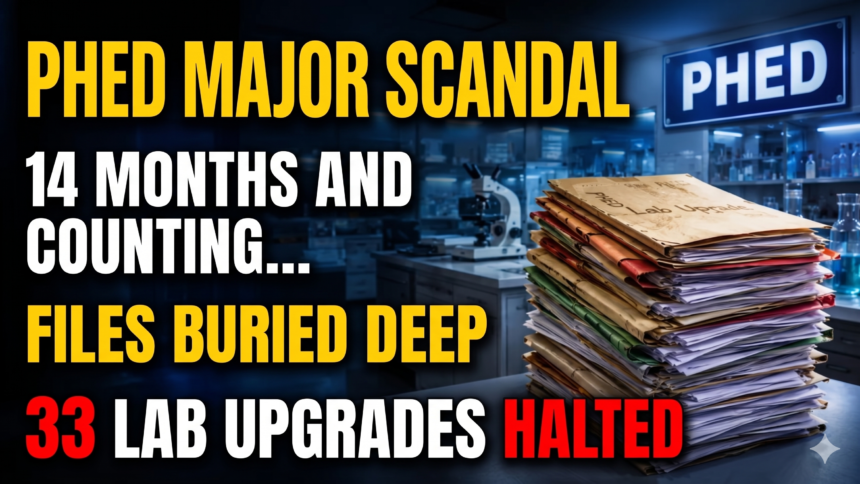
Jaipur: A major public health infrastructure project aimed at modernizing 33 district-level laboratories of Public Health Engineering Department in Rajasthan has remained stalled in government files for the last 14 months, raising serious questions over bureaucratic priorities and the push for outsourcing despite lower operational costs in government-run facilities.
The project, which involves establishing advanced microbiological clean rooms for water quality testing, was announced as part of the state government’s efforts to strengthen drinking water safety across Rajasthan. However, despite financial approval, administrative sanctions, and technical clearances, the work has not moved beyond meetings, agenda discussions, and repeated deferments.
Sources in the department allege that senior officials are insisting on outsourcing water testing operations to private agencies instead of upgrading PHED’s own laboratories, even though internal departmental calculations show that government-operated labs would be significantly cheaper in the long run.
Budget Announcement Trapped in Files for 14 Months
The project formally began in March 2025 after the Finance Department granted financial concurrence worth Rs 16.37 crore (Rs 1637.46 lakh). Administrative approval followed in April 2025, and by May 2025, region-wise technical sanctions for execution had already been issued.
Given the urgency surrounding drinking water quality monitoring, the project was expected to begin immediately. Instead, from March 2025 to May 2026, the proposal has remained stuck in official procedures, with repeated discussions and postponements delaying implementation.
More Read

Officials have continued citing the need for additional technical evaluations and reduction of “manual intervention” in testing procedures, even as the project remains inactive on the ground.
Department’s Own Data Questions Outsourcing Push
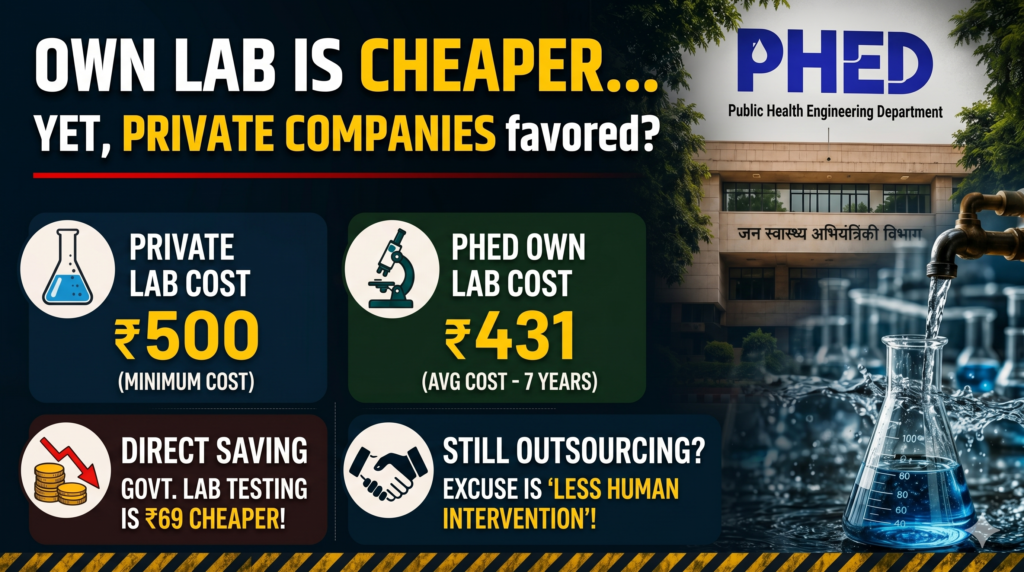
Internal reports prepared by PHED reportedly reveal a striking cost comparison between outsourcing water testing and strengthening departmental laboratories.
According to the findings:
More Read

- If microbiological testing for Total Coliform and E. coli bacteria is outsourced to private NABL-certified laboratories, the minimum cost comes to around Rs 500 per sample.
- If PHED upgrades and operates its own 33 district laboratories, the combined capital and recurring expenditure over seven years would bring the average testing cost down to approximately Rs 431 per sample.
The difference of Rs 69 per sample may appear small individually, but experts point out that when multiplied across lakhs of water samples tested annually, the financial burden on the public exchequer could run into crores of rupees.
Despite this, senior officials are reportedly favouring a complete outsourcing model, citing concerns about reducing human intervention in laboratory processes.
Expensive Foreign Technologies Used as Justification
Sources further revealed that PHED officials explored foreign automated technologies such as “IDEXX Tecta™” and “Solid-Phase Cytometry” for microbiological water testing.
However, departmental experts concluded that these technologies are not easily available in India and require highly expensive equipment and operational systems, making them impractical for large-scale implementation in Rajasthan.
The expert assessment reportedly stated that the existing Membrane Filtration Technique (MFT) remains the most practical, economical, and safe method currently available for microbiological testing in government laboratories.
Despite these findings, the proposal has repeatedly been delayed under the pretext of further technical review and evaluation.
More Read

Finance Committee Again Defers Proposal
In the latest development, the proposal was once again deferred during a meeting of the PHED Finance Committee. Sources said officials have now been instructed to place the matter before the EPC and re-examine the option of “complete outsourcing.”
The repeated deferments have intensified concerns that the project may continue to remain stalled unless consensus is reached on the outsourcing model being pushed by certain officials.
Public Health Concerns Grow
The delay comes at a time when several districts in Rajasthan continue to face concerns related to contaminated drinking water, including bacterial contamination and water-borne diseases.
Experts believe that district-level microbiological laboratories are essential for ensuring timely detection of contaminated water supplies and improving public health surveillance.
With the project stuck for more than a year, questions are now being raised over whether bureaucratic indecision and preference for private outsourcing are taking precedence over public health and financial prudence.