

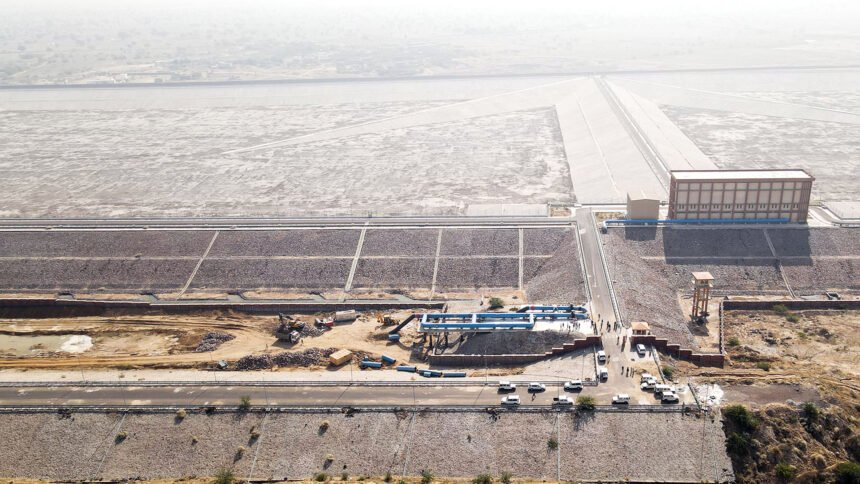
Barmer/Jaipur: A major controversy has surfaced around the ambitious Barmer Lift Water Supply Project Phase-II (BLWSP Phase-II Part-C KKD), after official records reportedly revealed serious administrative lapses, land disputes, and attempts to modify the scope of the project nearly nine years after the original work order was issued.
The project, launched to provide drinking water to several villages in the Shiv-Bhadkha region of Barmer district, was originally sanctioned at a cost of ₹595.34 crore. However, despite repeated extensions and years of expenditure, many villages linked to the scheme are still awaiting regular water supply.
The latest developments have intensified scrutiny on the functioning of Rajasthan’s Public Health Engineering Department (PHED), particularly over project planning, land verification, and contract management practices.
Project Issued in 2017, Still Incomplete in 2026
According to official documents, the work order for the mega drinking water project was issued on January 24, 2017, by the Chief Engineer (Projects), Jodhpur, to M/s VPRPL-WABAG JV.
The project included:
More Read

- ₹550.34 crore for construction work.
- ₹45 crore allocated for 10 years of operation and maintenance (O&M).
The original completion deadline reportedly expired in 2020, but due to repeated delays and incomplete execution, the project remains unfinished even in 2026.
Residents in several connected villages continue to face water shortages despite the massive expenditure incurred under the scheme.
₹3.53 Crore Work Approved Without Land Possession
The most controversial aspect of the case relates to a proposed Over Head Service Reservoir (OHSR) planned at Sansiyon Ka Tala village.
More Read

Documents reportedly show that PHED approved a budget of approximately ₹3.53 crore for the reservoir and associated infrastructure without ensuring clear ownership or physical possession of the land where the structure was to be built.
The land later became the subject of a legal dispute and is currently under consideration before the SDO Court in Barmer.
Officials reportedly neither verified the ownership status nor secured physical possession of the land before including the work in the project package and approving expenditure.
Sources indicate that the contractor had been informing the department since March 2021 regarding the unresolved land dispute, but no effective action was taken for years.
Proposal to Remove Work From Project Raises Questions
The controversy deepened after a proposal was placed before the Finance Committee (FC-917) meeting held on April 27, 2026.
In the meeting, the Chief Engineer, Jodhpur, reportedly suggested that the disputed ₹3.53 crore component be “de-scoped” from the project altogether so that the contractor could be issued a completion certificate and the contract formally closed.
More Read

However, members of the Finance Committee reportedly raised strong objections to the proposal.
Committee members questioned how water supply would reach the affected villages if the reservoir was removed from the project scope. Concerns were also raised regarding the future utility of the rising pipeline and distribution network connected to the proposed structure.
Officials reportedly noted that the agenda proposal failed to adequately explain the impact of removing the work on rural water supply obligations.
Finance Committee Defers Proposal
In view of the unresolved technical and operational issues, the Finance Committee reportedly deferred the proposal and directed that a detailed technical review be conducted before any final decision is taken.
The matter has now been referred to the Technical Committee for examination of the project feasibility, public impact, and contractual implications.
Questions Over Accountability and Planning Failure
The episode has sparked serious questions over administrative accountability within PHED.
Critics argue that:
- The department approved multi-crore infrastructure work without ensuring land availability.
- Repeated delays and legal disputes were ignored for years.
- Villages linked to the project continue to remain deprived of drinking water despite substantial expenditure.
- Attempts are now allegedly being made to alter the project scope in a manner that could benefit the contractor while leaving key infrastructure incomplete.
Observers also question why responsibility has not yet been fixed against officials involved in project planning, land verification, and monitoring.
Larger Concerns Over Water Infrastructure Governance
The BLWSP Phase-II controversy has once again highlighted larger structural concerns in Rajasthan’s water infrastructure management, including delays in execution, weak project oversight, inadequate field verification, and poor inter-departmental coordination.
The outcome of the Technical Committee review is now being closely watched, particularly to see whether accountability is established or the matter remains confined to procedural observations.
For residents of the affected villages, however, the central issue remains unchanged — despite years of announcements and crores of rupees spent, access to reliable drinking water is still incomplete.