

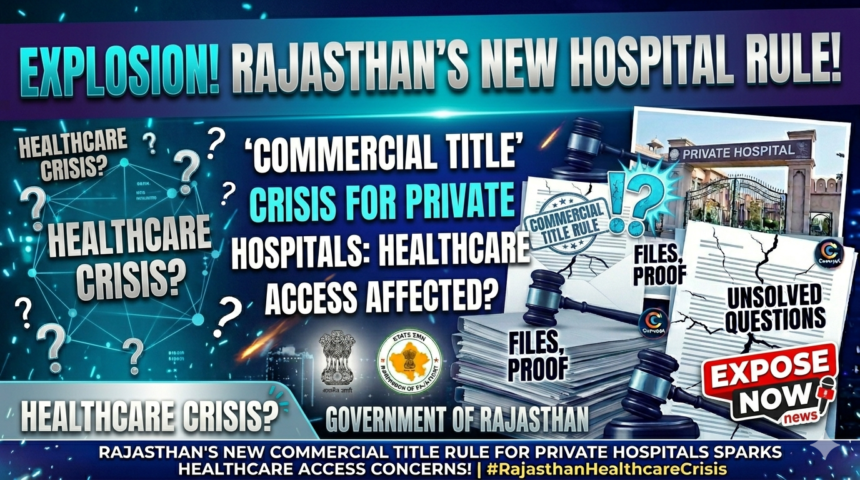
Jaipur, Rajasthan – The Rajasthan Medical and Health Department has introduced a requirement that private hospitals must have a “commercial title” in order to participate in government‑linked healthcare programmes and insurance schemes — a move that critics warn could worsen the state’s ongoing healthcare crisis.
Under the revised policy, private hospitals must possess a recognised commercial title — indicating proper legal and regulatory categorisation as business entities — before they can be empanelled for schemes like the Ayushman Bharat‑Rajasthan Chief Minister Arogya Yojana and the Rajasthan Government Health Scheme (RGHS). Hospitals without such commercial titles may be barred from cashless treatment networks and reimbursements, potentially limiting where patients can access subsidised care.
🏥 Potential Impact on Healthcare Access
Activists and healthcare observers worry this procedural change could reduce the number of hospitals willing or able to participate in government schemes, leading to restricted access for patients who rely on subsidised treatments. Previously, many private facilities — including smaller and mid‑sized hospitals — were empanelled based on licensing and healthcare standards alone. The new mandate could exclude those without formal commercial titles, affecting cashless services and treatment availability for thousands of families.
The issue is drawing attention at a time when Rajasthan’s public‑private healthcare dynamics are already under strain. Reports indicate disputes between hospital associations and the state government over unpaid dues under the RGHS, with some private facilities threatening to suspend services due to delayed reimbursements — a situation that has already disrupted treatment access in parts of the state.
📊 Broader Concerns on Healthcare System and Regulations
The new commercial title requirement is seen by some as part of wider regulatory pressure on private healthcare providers, who argue they are facing policy gaps and financial challenges in delivering services under government‑sponsored insurance schemes. Delays in payments, eligibility criteria changes, and administrative burdens are cited as factors stressing the system.
More Read
Public health activists also highlight that despite state laws like the Rajasthan Right to Health Care Act, 2022 — which aims to guarantee free healthcare for residents in both public and certain private settings — implementation and enforcement challenges remain, especially around reimbursement frameworks and provider participation.
📣 Calls for Review and Dialogue
Patient rights groups, hospital associations, and advocacy organisations are calling on the government to clarify the scope and necessity of the commercial title rule, ensure timely payments to private empanelled hospitals, and engage in a broader review of healthcare regulations. They argue that without transparent policy implementation and timely funding support, such administrative measures could unintentionally reduce access to essential medical services, especially for low‑income patients and rural communities.
The state health department has not yet issued a detailed public response explaining the rationale behind the commercial title requirement or outlining how it plans to safeguard uninterrupted healthcare access for patients relying on government schemes.