

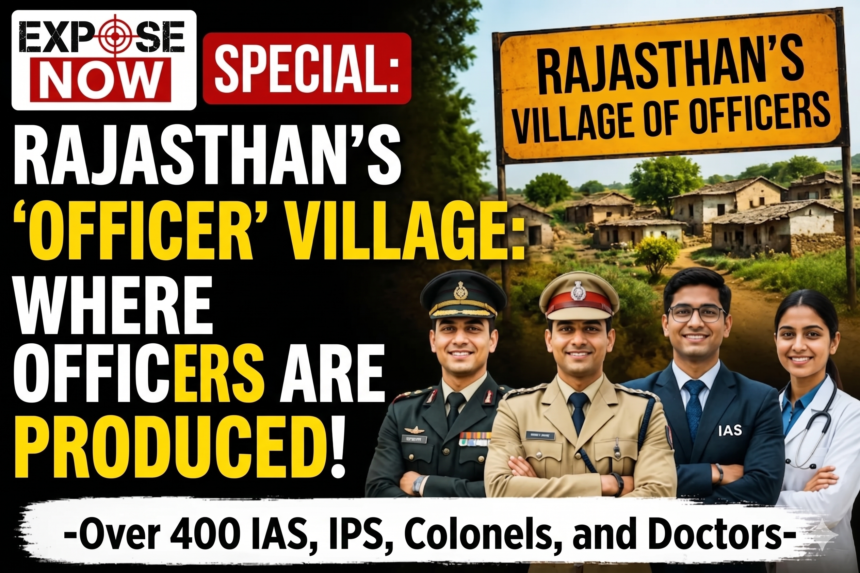
Jhunjhunu/Jaipur: In the heart of Rajasthan’s Shekhawati region lies a remarkable success story that has transformed a small rural belt into one of India’s most inspiring examples of educational achievement and public service. The village of Nua in Jhunjhunu district, along with nearby hamlets, is today widely known as the “Village of Officers” for producing an extraordinary number of civil servants, military officers, doctors, engineers and administrators.
With a population of around 12,000, Nua has reportedly produced between 300 and 400 individuals serving in prestigious positions across the Indian Administrative Service (IAS), Indian Police Service (IPS), armed forces, education sector, and various government departments.
Locals proudly say that in this village, children grow up not merely aspiring for jobs, but dreaming of serving the nation from positions of leadership and responsibility.
The Beginning of an Educational Revolution
The roots of this transformation date back nearly a century.
In 1931, Captain Taj Mohammad, who served in the British Indian Army, established a government primary school in the village. At a time when education was considered inaccessible in many rural areas, the school became a symbol of opportunity and social progress.
More Read

Over the decades, the institution expanded into a senior secondary school and gradually emerged as an educational hub for the surrounding region.
Philanthropists such as Seth Phoolchand Jalan further strengthened the movement by contributing towards school infrastructure, hospitals, and public utilities including water facilities.
As educational facilities improved, children from nearby villages also began migrating to Nua for studies, creating an environment where academic achievement became deeply rooted in the local culture.
More Read

A Tiny Hamlet With Officers in Nearly Every Household
Perhaps the most astonishing example of this transformation is Krishniyon Ka Bas, a small settlement located about 1.5 kilometres from Nua.
Despite having a population of barely 250 to 300 people, the village has produced an exceptional number of senior officials and professionals.
According to local records and residents:
- 4 officers have joined the Rajasthan Administrative Service (RAS).
- 2 officers have reached the Indian Police Service (IPS).
- 2 officers have served as Additional Superintendents of Police (ASP).
- 2 individuals have attained the rank of Colonel in the Indian Army.
- Several doctors, engineers, principals, teachers and forest officers also belong to the village.
Residents say that almost every household in the hamlet has someone serving in a respected professional or administrative position.
Women Leading the Way
The region’s achievements are not limited to male officers alone. Women from the village have also carved out distinguished careers in national service.
One of the most prominent names is Colonel Ishrat Ahmad, who became Rajasthan’s first woman colonel to command an ordnance unit in the Indian Army. She is currently serving in Maharashtra.
More Read

Her family itself represents a tradition of military service. Her father, Zaki Ahmad, served as a Colonel, while her brother, Shakib Hussain, has served as a Brigadier in the Indian Army.
Locals consider her achievement a matter of immense pride and an inspiration for young girls across the region.
A Culture of Mentorship and Competitive Spirit
Educationists and residents believe the success of Nua and surrounding villages is the result of a powerful cycle of mentorship and aspiration.
As one generation entered civil services, defence forces and professional careers, younger students began viewing such achievements as realistic goals rather than distant dreams.
Senior officers from the region are known to guide students preparing for competitive examinations, creating a strong support network for aspiring candidates.
This culture has gradually spread to neighbouring villages including Tai, Patoda, Bharu and Dhigal, turning the wider 30-kilometre belt into what locals describe as a “nursery of officers.”
A Model of Rural Educational Transformation
The story of Nua reflects how long-term investment in education and community support can fundamentally transform rural society across generations.
At a time when many rural regions continue to struggle with access to quality education and career opportunities, this small Shekhawati belt has emerged as a model of how educational awareness, discipline and mentorship can create lasting social change.
For the people of Nua, success is no longer viewed as an exception — it has become a tradition passed from one generation to the next.