

New Delhi | April 2026
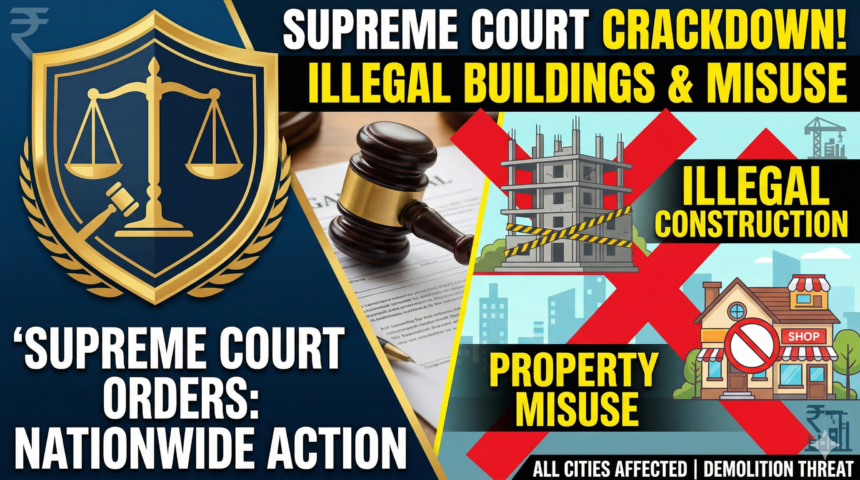
In a significant ruling aimed at curbing widespread urban violations, the Supreme Court of India has directed authorities across the country to conduct a comprehensive survey and investigation into illegal constructions and the misuse of residential properties for commercial purposes.
The apex court observed that large-scale violations of building bylaws and zoning regulations have become a growing concern in many cities, leading to unplanned urban development, civic strain, and hardship for genuine residents.
Nationwide Survey Ordered
The Supreme Court has ordered all municipal corporations and urban local bodies in state and Union Territory capitals to identify residential properties being illegally converted for commercial use such as shops, offices, and other business establishments.
Authorities have been directed to submit detailed affidavits regarding violations by May 15, 2026, ensuring strict compliance with urban planning norms.
More Read

The court emphasized that such illegal conversion of residential areas is not only against the law but also severely impacts public convenience, safety, and environmental conditions.
Court’s Strong Observations
The bench noted that in several cities, entire residential colonies are being gradually transformed into commercial hubs without proper approval from planning authorities.
The Supreme Court highlighted that these practices result in:
More Read

- Traffic congestion and parking issues
- Disturbance to peaceful residential living
- Violation of sanctioned master plans
- Environmental and civic pressure on urban infrastructure
The court further stressed that authorities cannot remain passive and must take strict enforcement action against such violations.
Focus on Urban Planning Compliance
The directive has placed municipal bodies under strict scrutiny, making them responsible for ensuring that building bylaws are properly enforced.
Urban development experts say the order will likely trigger large-scale surveys in major cities, including Jaipur, Delhi, Mumbai, and Bengaluru, where commercial activity in residential zones has been steadily increasing.
The court also reiterated that illegal constructions and unauthorized usage of land cannot be regularized simply due to delay or negligence by authorities, reinforcing the principle of strict compliance with law.
Impact Across States
Following the Supreme Court’s directive, several municipal corporations across India are expected to launch inspection drives to identify illegal conversions and unauthorized constructions.
In multiple cities, similar enforcement actions have already begun, including sealing drives, demolition notices, and property inspections.
More Read

Officials are also expected to prepare action plans for removal or regularization, depending on legal provisions and zoning rules.
Conclusion
The Supreme Court’s nationwide directive marks a major step toward restoring planned urban development and strengthening enforcement of building laws. The decision is expected to have wide-reaching implications for property owners, municipal authorities, and urban planners across India.
As the deadline approaches, cities are likely to witness intensified inspections and corrective action against unauthorized commercial activities in residential areas.