
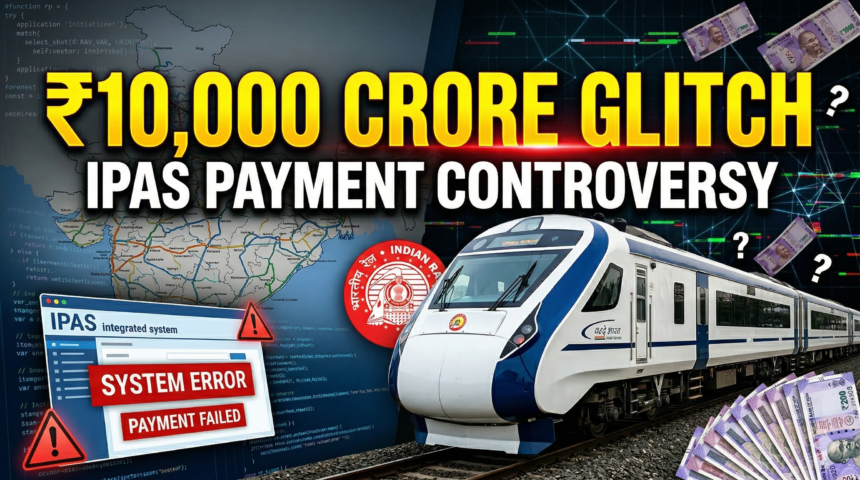
New Delhi, India: A massive technical malfunction in the Indian Railways’ Integrated Payroll and Accounting System (IPAS) has triggered concerns over erroneous payments and accounting discrepancies amounting to an estimated ₹10,000 crore, spotlighting flaws in the railways’ digital financial infrastructure.
The IPAS software — designed to process employee salaries, allowances, pensions, vendor payments, and other financial transactions — has reportedly experienced significant system errors and validation failures that allowed incorrect financial entries to be processed without adequate checks. This raised fears of major fiscal losses and irregular payouts across various departments of Indian Railways.
What Is IPAS and Why It Matters
The Integrated Payroll and Accounting System (IPAS) is a centralized digital platform rolled out across Indian Railways to manage payroll, accounting, budget controls, pension records and other financial functions. The objective was to reduce manual intervention, improve accuracy, and streamline payments across one of India’s largest public sector employers.
However, audits and internal reviews have repeatedly flagged data inconsistencies, lack of real‑time validation controls, and incomplete reconciliation within IPAS. In some instances, legacy data from older systems wasn’t fully migrated or verified before processing, allowing flawed entries to be passed.
Allegations of Erroneous Payments
Officials and financial experts believe that system errors in IPAS led to erroneous payment approvals, including overpayments of allowances, inaccurate pension payouts, and vendor bills processed without proper authorization. While the exact figure is still under review, preliminary estimates indicate the impact could be as high as ₹10,000 crore — a substantial gap in a system that handles billions of rupees annually. (Reported claim from exposenow article)
More Read

The glitch reportedly allowed payroll and accounting entries that bypassed critical validation checks, exposing weakness in built‑in controls once relied upon to prevent duplicate or incorrect payouts.
Compounding Digital Risk
Railway auditors have noted that IPAS lacks real‑time integration with other key financial and HR systems, such as Human Resource Management System (HRMS) and legacy accounting platforms. This fragmentation has contributed to delays in detecting inconsistencies and reconciling records across modules, allowing some payments to slip through unchecked.
Experts point out that large‑scale digital systems without robust validation — especially in mission‑critical domains like payroll and accounting — are vulnerable to data corruption and systemic errors if not properly audited and monitored.
More Read

Passenger and Employee Impact
Although the glitch primarily affects backend accounting, the controversy has begun influencing public perception of Indian Railways’ digital capabilities. There have been anecdotal reports from passengers and employees about failed payments, ticketing errors, and digital transaction issues on railway apps, although these are separate from the IPAS issue and more commonly tied to front‑end platforms like ticketing systems.
Railway personnel have also raised concerns about delays in salary or pension disbursements, prompting union representatives to demand clarity and corrective action from the Ministry of Railways.
Government and Audit Response
In response to rising concerns, auditing bodies — including the Comptroller and Auditor General (CAG) — are examining the implementation and functioning of IPAS. Previous audit reports had already highlighted gaps in data validation and incomplete system deployment, urging the railways to strengthen internal controls.
Railway officials have assured that an internal probe is underway and that steps will be taken to identify and reverse any incorrect payments. However, the magnitude of the alleged financial impact has prompted calls for an independent investigation.
Broader Context: Railways Digital Transformation
The IPAS controversy occurs amid a broader digital transformation effort by Indian Railways, which has been upgrading safety, ticketing, and accounting systems across its network. This includes recent investments in modern protocols and digital services.
But as the system grows increasingly digitized, experts emphasize the need for stronger audit mechanisms, real‑time monitoring, and cross‑system integration to prevent software glitches from translating into fiscal losses.