

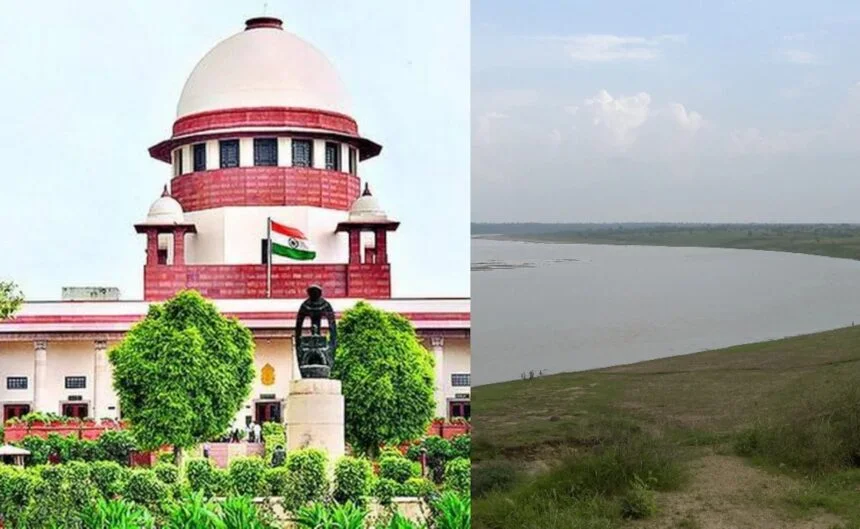
Jaipur : Taking a stern view of rampant illegal mining in the National Chambal Sanctuary, the Supreme Court on Thursday made it clear that merely arresting drivers and seizing vehicles would not be enough to dismantle the mining nexus operating in the ecologically sensitive region. The Court emphasized that authorities must identify and act against the “big players” and masterminds behind the illegal operations.
A Division Bench comprising Justice Vikram Nath and Justice Sandeep Mehta was hearing the suo motu matter concerning illegal mining activities in the National Chambal Sanctuary.
During the hearing, the apex court observed that it would not be satisfied with “paper plans, assurances, or affidavits” submitted by governments unless visible and effective action was reflected on the ground. The Bench remarked that the illegal mining network could not be dismantled by targeting only poor drivers and vehicle operators while the key masterminds remained untouched.
Court Directs Faster Recruitment of Forest Staff
The Supreme Court also directed the Rajasthan government to expedite the recruitment process for vacant posts of forest guards, rangers, and other field personnel responsible for protecting forests and wildlife in the Chambal region.
The Court noted that strengthening field enforcement was essential to preserving the fragile river ecosystem and controlling organized illegal mining activities.
More Read

Rajasthan’s Integrated Monitoring System Wins Praise
While issuing strict directions, the Court also appreciated the Rajasthan government’s proposed integrated monitoring framework to curb illegal mining. The Bench observed that the technological model being developed by the state could eventually serve as a “role model” for other states dealing with similar environmental crimes.
The hearing witnessed the personal presence of several senior officials, reflecting the seriousness of the matter. Those present included Additional Chief Secretaries of Home, Forest and Environment, and Mines and Petroleum departments, along with senior transport officials, police officers, the Principal Chief Conservator of Forests (PCCF), and the Chief Wildlife Warden.
Representing the state, Additional Solicitor General Aishwarya Bhati and Additional Advocate General Shiv Mangal Sharma informed the Court that following the Supreme Court’s earlier order dated May 14, 2026, the Chief Secretary had directed all concerned departments to work in close coordination.
More Read

AI-Based Surveillance Planned at 40 Hotspots
The Forest Department submitted a detailed action plan before the Court, stating that 40 highly sensitive hotspots within the Chambal Sanctuary area had been identified where illegal mining activities were most prevalent.
Under the proposed plan:
- AI-based high-resolution CCTV surveillance systems will be installed at all 40 identified hotspots.
- The surveillance network will be directly connected to a central command and control centre for real-time monitoring.
- Authorities will receive immediate alerts regarding suspicious movement or illegal mining activity.
- GPS tracking systems are being rapidly deployed in tractors, dumpers, excavators, and other heavy vehicles suspected to be involved in illegal mining.
GPS Installation in Mining Vehicles by July 31
The Mines Department informed the Court that GPS installation work was being carried out on a war footing across mining and transport vehicles operating in districts adjoining the Chambal region, including Dholpur, Karauli, Sawai Madhopur, Bundi, and Kota.
According to the government, the process of mandatory GPS installation is expected to be completed by July 31, 2026.
Meanwhile, the Transport Department informed the Court that a pilot project had already been launched in Dholpur district, where GPS systems have been made compulsory for all registered mining vehicles. Officials stated that any violation of the new monitoring rules would invite strict action, including immediate seizure of vehicles.
Focus on Ecological Protection
The National Chambal Sanctuary is considered one of India’s most ecologically important riverine habitats and is home to endangered species such as the gharial, Gangetic dolphin, and several migratory birds. Environmental experts have repeatedly warned that unchecked illegal mining has severely damaged riverbanks, aquatic biodiversity, and wildlife habitats in the Chambal region.
More Read

With the Supreme Court now directly monitoring the matter, officials are expected to face increased accountability in implementing anti-mining measures on the ground.