

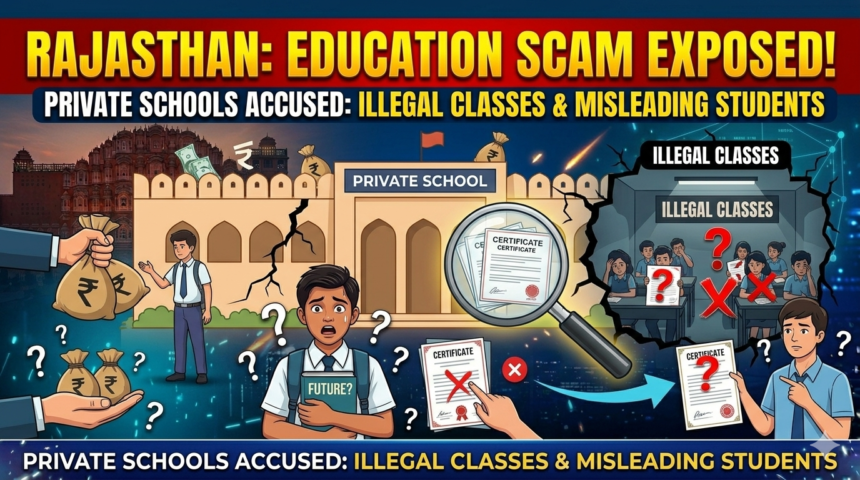
Jaipur/Udaipur, Rajasthan: A fresh controversy has emerged in Rajasthan’s education sector after serious allegations surfaced against several private schools for running illegal classes, misusing CBSE affiliation, and operating without proper regulatory approvals. The issue has sparked outrage among parents and activists, with demands for strict action against institutions and accountability from the education department.
Illegal Classes and “Dummy School” Model
According to reports and complaints highlighted by activists, several private schools in Rajasthan are allegedly conducting classes in unauthorized premises or operating parallel coaching-style setups outside approved campuses. These institutions are accused of enrolling students formally but allowing them to skip regular schooling—a practice commonly referred to as “dummy schooling.”
This model enables students to focus on competitive exam coaching while remaining officially enrolled in schools. However, such practices violate academic norms and undermine the formal education system.
The seriousness of the issue has already been acknowledged at the judicial level. The Rajasthan High Court recently termed the rise of dummy schools a major threat, noting that many institutions allow students to remain absent from classrooms while focusing solely on coaching institutes.
Misuse of CBSE Affiliation
One of the most alarming aspects of the alleged scam is the misuse or false projection of affiliation with the Central Board of Secondary Education (CBSE).
More Read

Sources claim that some schools are:
- Advertising CBSE affiliation without full compliance
- Running classes beyond approved grades or infrastructure
- Using shared or unauthorized campuses
- Failing to meet mandatory safety and academic standards
Recent enforcement actions across India highlight how serious such violations are. In one case, CBSE suspended a school’s affiliation after finding major discrepancies in infrastructure, documentation, and safety compliance.
These developments suggest that similar irregularities in Rajasthan could lead to strict penalties if proven.
More Read

Role of Education Department Under Question
Activists, including members of civil society groups such as Mirror Foundation, have raised concerns over the alleged inaction or silence of the Rajasthan education department despite repeated complaints.
Questions being raised include:
- How are schools operating illegal classes without inspections?
- Why are affiliation violations not being detected early?
- Are authorities ignoring complaints or delaying action?
Critics argue that the lack of timely intervention points toward administrative negligence—or potentially deeper systemic issues.
Impact on Students and Parents
The alleged scam has serious implications for students and their families:
- Students may face uncertainty regarding the validity of their education and board certifications
- Parents are often unaware of irregularities and pay high fees for substandard or unauthorized schooling
- Academic quality suffers when schools prioritize commercial gains over education
In extreme cases, regulatory action such as de-affiliation can disrupt students’ academic continuity, forcing them to shift schools mid-session.
Growing Pattern of Violations
The controversy appears to be part of a wider pattern in Rajasthan’s private education sector. Authorities and courts have repeatedly flagged:
More Read

- Commercialization of education
- Nexus between schools and coaching institutes
- Lack of compliance with CBSE norms
- Safety and infrastructure deficiencies
These issues indicate systemic gaps that require urgent reform.
Demand for Investigation and Accountability
In light of the allegations, activists and concerned citizens are demanding:
- A high-level inquiry into private schools operating illegally
- Verification of CBSE affiliation claims across institutions
- Strict action against schools violating norms
- Accountability of officials responsible for oversight
There are also calls for increased transparency, including public access to affiliation records and regular inspection reports.
Conclusion
The Rajasthan private school scam has exposed serious cracks in the regulation of private education. From illegal classes to misuse of CBSE affiliation, the allegations point toward a system that may be failing to protect students’ interests.
As pressure mounts on authorities, the coming weeks will be crucial in determining whether decisive action is taken—or whether the issue continues to be ignored, risking the future of thousands of students across the state.